1.1 Data Representation
AS Level · 3 questions found
What this topic covers
Section titled “What this topic covers”- Binary prefixes vs decimal prefixes: kibi/kilo, mebi/mega, gibi/giga, tebi/tera
- Number systems: binary, denary, hex, BCD; one’s & two’s complement
- Convert between number bases and representations
- Binary addition & subtraction; understand overflow
- Practical applications of BCD and hexadecimal
- Character data: ASCII, extended ASCII, Unicode
Past paper questions
Section titled “Past paper questions” Q7

7
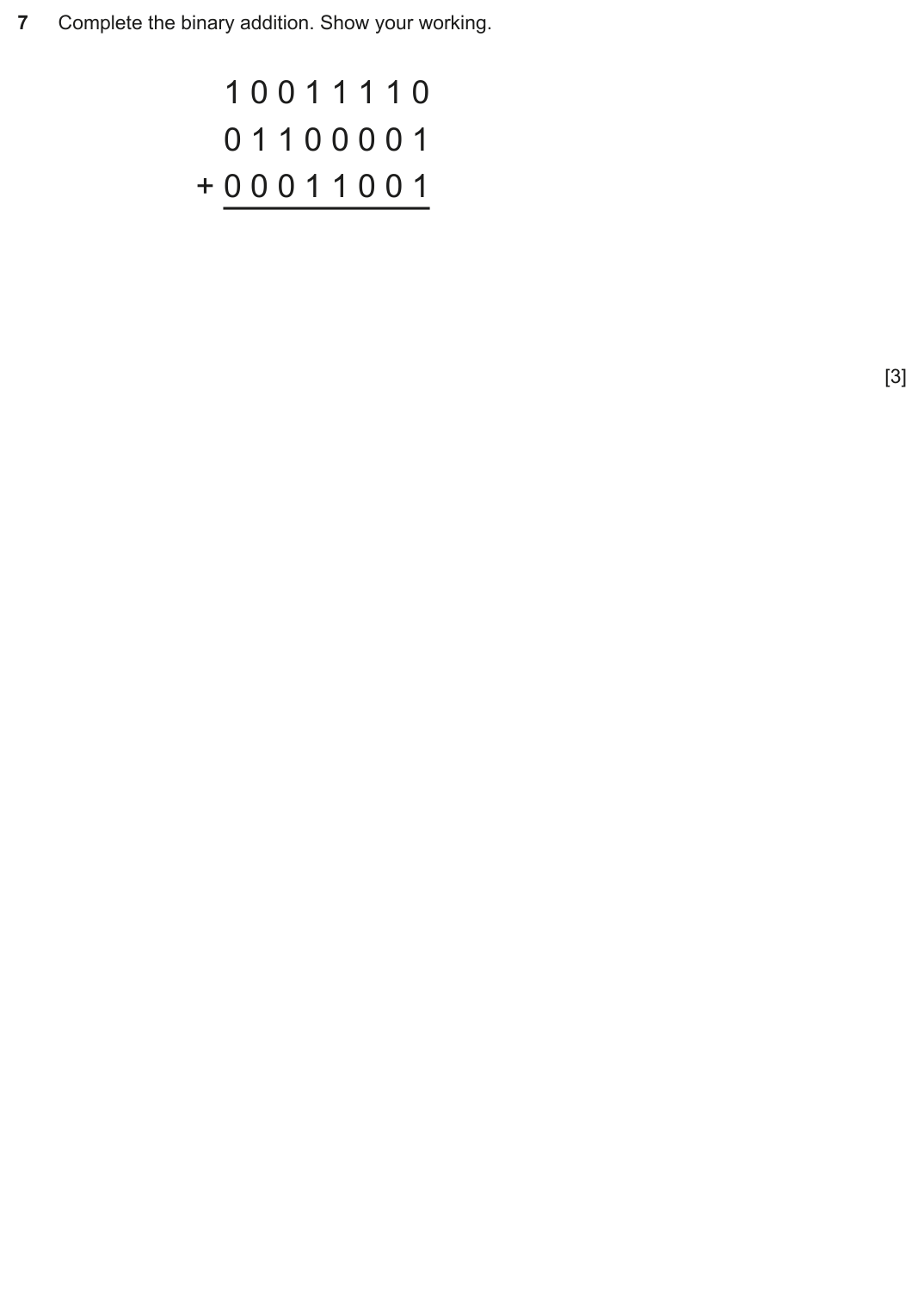
Complete the binary addition. Show your working.
1 0 0 1 1 1 1 0
0 1 1 0 0 0 0 1
+ 0 0 0 1 1 0 0 1
[3]
Show mark scheme
7 [3 marks]
1 mark
each:
Working – carried values clearly indicted
Correct answer 0001 1000
Overflow clearly indicated as overflow
Example:
1 0 0 1 1 1 1 0
0 1 1 0 0 0 0 1
+ 0 0 0 1 1 0 0 1
(1) 0 0 0 1 1 0 0 0
1 1 1 1 1 1 1........................(carries)
each:
Working – carried values clearly indicted
Correct answer 0001 1000
Overflow clearly indicated as overflow
Example:
1 0 0 1 1 1 1 0
0 1 1 0 0 0 0 1
+ 0 0 0 1 1 0 0 1
(1) 0 0 0 1 1 0 0 0
1 1 1 1 1 1 1........................(carries)
Q7

7
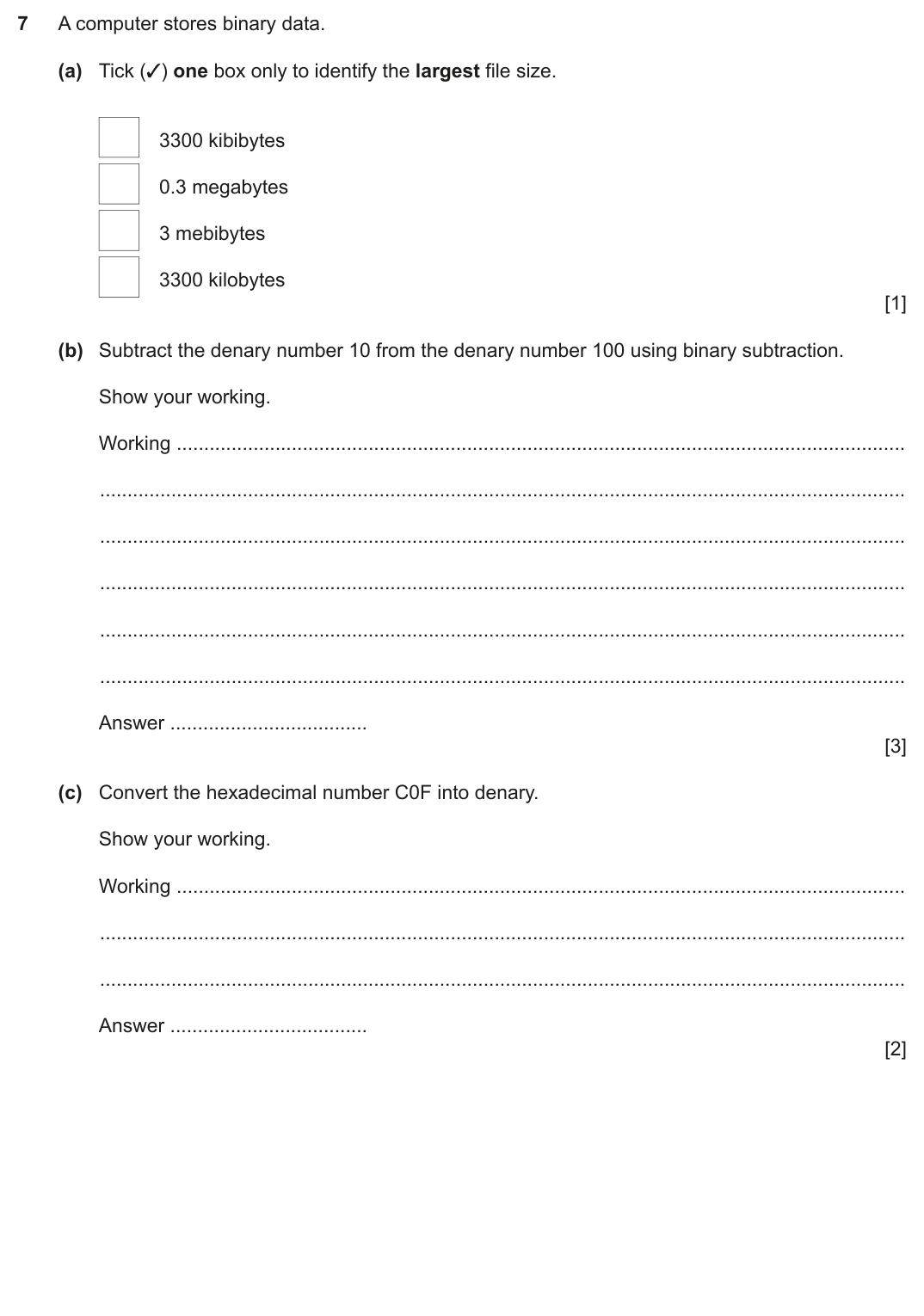
A computer stores binary data.
(a) Tick (3) one box only to identify the largest file size.
3300 kibibytes
0.3 megabytes
3 mebibytes
3300 kilobytes
[1]
(b) Subtract the denary number 10 from the denary number 100 using binary subtraction.
Show your working.
Working .....................................................................................................................................
Answer ....................................
[3]
(c) Convert the hexadecimal number C0F into denary.
Show your working.
Working .....................................................................................................................................
Answer ....................................
[2]
Show mark scheme
7(a)
1 mark
for:
3300 kibibytes
for:
3300 kibibytes
7(b) [2 marks]
1 mark
each:
Converting 100 to binary
0110 0100
and
10 to binary
0000 1010
Subtraction method - converting 10 to – 10 and adding // direct
subtraction …
… correct answer
0101 1010
Method 1: Converting to -10 and adding:
Binary for +10 is 0000 1010
Binary for –10 is 1111 0110
Binary for 100 is 0110 0100
100 + (-10):
0 1 1 0 0 1 0 0
+1 1 1 1 0 1 1 0
(1) 0 1 0 1 1 0 1 0
Carries: 1 1 0 0 1 0 0 0
Method 2: Direct Subtraction
Borrows:
0 0 0 1 1 0 1 0
0 1 1 0 0 1 0 0
– 0 0 0 0 1 0 1 0
0 1 0 1 1 0 1 0
each:
Converting 100 to binary
0110 0100
and
10 to binary
0000 1010
Subtraction method - converting 10 to – 10 and adding // direct
subtraction …
… correct answer
0101 1010
Method 1: Converting to -10 and adding:
Binary for +10 is 0000 1010
Binary for –10 is 1111 0110
Binary for 100 is 0110 0100
100 + (-10):
0 1 1 0 0 1 0 0
+1 1 1 1 0 1 1 0
(1) 0 1 0 1 1 0 1 0
Carries: 1 1 0 0 1 0 0 0
Method 2: Direct Subtraction
Borrows:
0 0 0 1 1 0 1 0
0 1 1 0 0 1 0 0
– 0 0 0 0 1 0 1 0
0 1 0 1 1 0 1 0
7(c)
1 mark
for working:
1100 0000 1111 // 2048 + 1024 + 8 + 4 + 2 + 1
// (12 * 16
) + 15 // (12 * 16
* 16) + 15 // 3072 + 15
2
1 mark
for correct answer:
3087
for working:
1100 0000 1111 // 2048 + 1024 + 8 + 4 + 2 + 1
// (12 * 16
) + 15 // (12 * 16
* 16) + 15 // 3072 + 15
2
1 mark
for correct answer:
3087
Q1

1
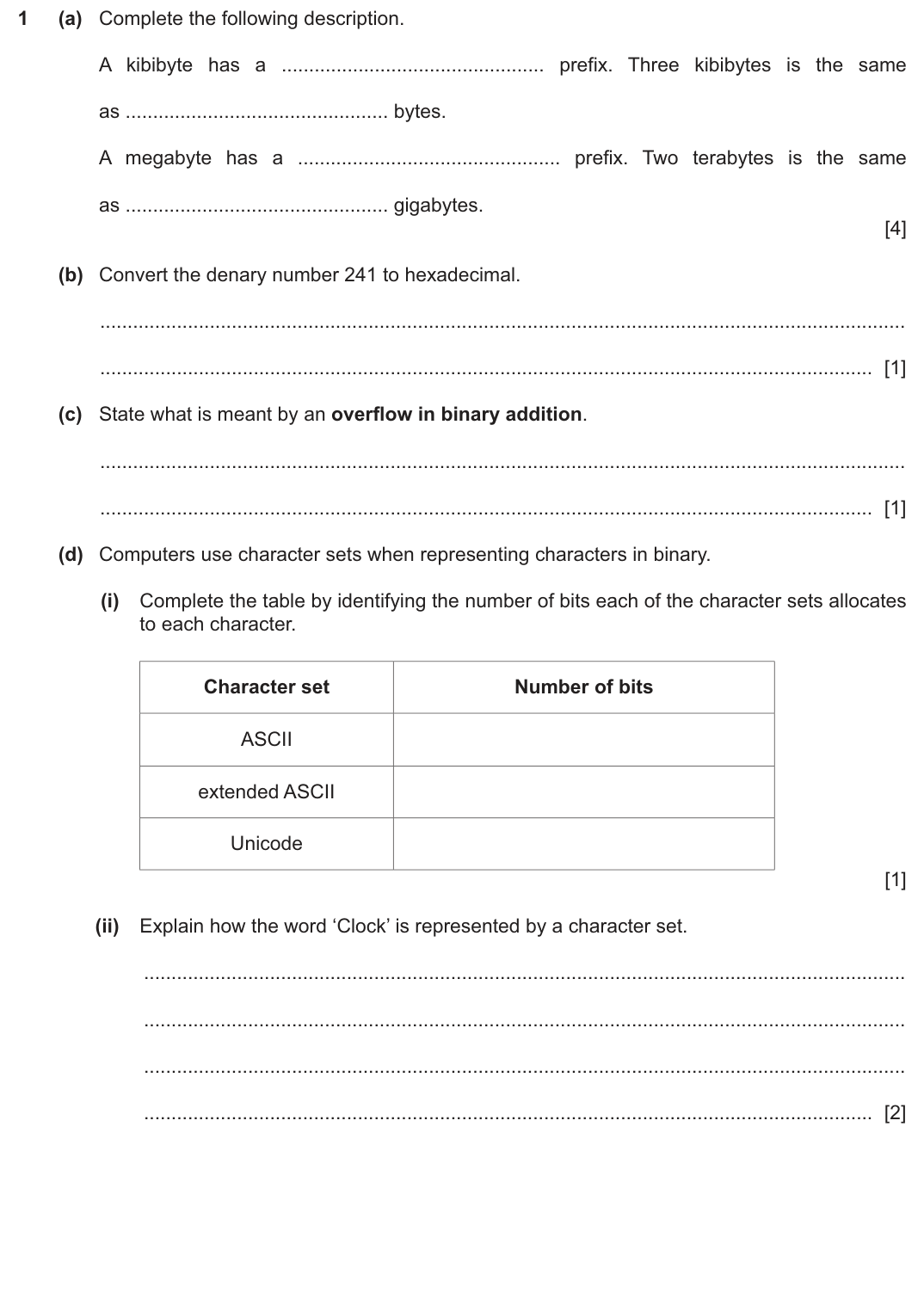
(a) Complete the following description.
A kibibyte has a ................................................ prefix. Three kibibytes is the same
as ................................................ bytes.
A megabyte has a ................................................ prefix. Two terabytes is the same
as ................................................ gigabytes.
[4]
(b) Convert the denary number 241 to hexadecimal.
............................................................................................................................................. [1]
(c) State what is meant by an overflow in binary addition.
............................................................................................................................................. [1]
(d) Computers use character sets when representing characters in binary.
(i) Complete the table by identifying the number of bits each of the character sets allocates
to each character.
Character set
Number of bits
ASCII
extended ASCII
Unicode
[1]
(ii) Explain how the word ‘Clock’ is represented by a character set.
..................................................................................................................................... [2]
,
,
Show mark scheme
1(a) [4 marks]
1 mark
for each correct answer:
binary
3072
denary/decimal
2000
A kibibyte has a
binary
prefix. Three kibibytes is the same as
3072
bytes.
A megabyte has a
decimal/denary
prefix. Two terabytes is the same as
2000
gigabytes.
for each correct answer:
binary
3072
denary/decimal
2000
A kibibyte has a
binary
prefix. Three kibibytes is the same as
3072
bytes.
A megabyte has a
decimal/denary
prefix. Two terabytes is the same as
2000
gigabytes.
1(b) [1 mark]
1 mark
for correct answer:
F1
for correct answer:
F1
1(c)
1 mark
for a correct answer:
The answer is too long to be represented in
the same number of bits
as the
binary numbers being added
for a correct answer:
The answer is too long to be represented in
the same number of bits
as the
binary numbers being added
1(d)(i) [2 marks]
1 mark
for all 3 answers correct:
Character set
Number of bits
ASCII
7
extended ASCII
8
Unicode
16
/
32
for all 3 answers correct:
Character set
Number of bits
ASCII
7
extended ASCII
8
Unicode
16
/
32
1(d)(ii)
1 mark
each:
Each character has a
unique
binary code
The binary code for each character is stored in sequence
each:
Each character has a
unique
binary code
The binary code for each character is stored in sequence