3.1 Computers & Components
AS Level · 34 questions found
What this topic covers
Section titled “What this topic covers”- Input, output, primary memory and secondary (removable) storage
- Embedded systems: benefits and drawbacks
- Hardware devices: laser/3D printer, microphone, speakers, HDD, SSD, optical, touchscreen, VR headset
- Buffers; RAM vs ROM; SRAM vs DRAM differences and use cases
- PROM, EPROM, EEPROM differences
- Monitoring vs control systems; sensors (temperature, pressure, IR, sound), actuators, feedback
Past paper questions
Section titled “Past paper questions”Describe the differences between a monitoring system and a control system. 3 marks
Show mark scheme
9 [3 marks]
1 mark per bullet point, max 3 marks • Monitoring systems do not take any action whereas control systems act autonomously to change the environment if the values are out of a prescribed range • Control systems use actuators monitoring systems do not have any actuators • Control systems make use of feedback monitoring systems do not make use of feedback • The output from a monitoring system does not affect the subsequent input whereas output from a control system affects the next input.
An architect needs a model of a building.
(a) Explain how the model will be printed using a 3D printer. 3 marks
(b) State why a 3D printer needs a buffer. 1 mark
Show mark scheme
10(a) [3 marks]
1 mark per bullet point, max 3 marks Generic mark points: (max 3) • Additive manufacturing • Uses a digital file created from 3D modelling software or Computer Aided Design (CAD) software • The printer builds up the model one layer at a time • The process is repeated for each layer • Some materials may need time to cool and set or UV curing using LEDs for photopolymer resins Specific mark points: (max 1) e.g. • Fused Deposition Modelling (FDM) // Material is heated and pushed through nozzle / extruder • Stereolithography (SLA) // Photosensitive liquid resin is exposed to a UV- laser beam • Digital Light Processing (DLP) // Photosensitive liquid resin is exposed to a UV projected image of the layer to cure the resin • Selective Laser Sintering (SLS) // Uses a laser to form objects from powdered material, the material can be plastics or metals
10(b) [1 mark]
1 mark • To free up the processor to carry out other tasks as the rate data is received by the printer is different from the rate at which it can be processed • To manage the mismatch in speed between the processor and the peripheral / 3D printer
An automated system opens doors when a person is detected within 2 metres. The system closes the doors when there is no longer a person within 2 metres.
Identify whether the automated system is an example of a monitoring system or a control system.
Justify your choice.
Monitoring or Control
Justification 3 marks
Show mark scheme
11 [3 marks]
1 mark per bullet point, max 3 marks Identification: Control system (no mark) Justification: • The system uses an actuator to open or close the doors • The output / opening the doors allows people to move, which changes the input to the sensor • The system acts autonomously on the feedback from a sensor
A shop installs a new system that allows users to purchase items without going through a manual checkout.
The new system:
identifies customers when they enter the shop and matches them to their account
prevents a customer from walking through the automatic barriers if they do not have an account
automatically detects the items that a customer has taken from a shelf and charges these to the customer’s account.
(a) The new system uses digital cameras and Artificial Intelligence (AI) to identify the customers. 4 marks
Explain how the new system uses AI to identify each customer.
(b) The new system uses sensors to identify the items taken from a shelf. 2 marks
Identify one type of sensor that can be used in this new system.
State how the sensor can be used to identify the items taken from a shelf.
Sensor
Use
Show mark scheme
4(a) [4 marks]
1 mark each to max 4 e.g. • Uses image recognition / facial recognition • Measures the distance between facial features of the customer • and stores the values in a database of user information • An image is captured using the digital camera • the AI identifies that the image is a face • by analysing the pixels to find patterns • the distance between features is calculated and compared to those in database
4(b) [2 marks]
1 mark for sensor, 1 mark for corresponding use e.g. Sensor Use Pressure Detects when the pressure of an item is removed from a shelf / put back on a shelf Infrared Detects when the beam is broken for an item removed / added
A programmer is buying a new computer.
(a) The programmer is considering the following two computers:
| Computer 1 | Quad‑core 2.2 GHz processor 16‑bit architecture 1 GB Random Access Memory (RAM) 500 GB magnetic hard disk |
|---|---|
| Computer 2 | Dual‑core 3.8 GHz processor 32‑bit architecture 2 GB RAM 500 GB solid state drive (SSD) |
(i) Computer 1 has a magnetic hard disk. 4 marks
Complete the description of the principal operation of a magnetic hard disk by writing the missing words.
The magnetic hard disk has one or more ______ that can be
magnetised. These are mounted on a ______ and rotate at
high speed.
A ______ is moved across the surface on an arm.
When data is read, the changes in the ______ produce
a change in the electric current.
(ii) The two computers have different amounts of RAM. 3 marks
Explain how different amounts of RAM affect the performance of a computer.
(iii) The two computers have different bus widths. 2 marks
Explain how different bus widths affect the performance of a computer.
(b) Both computers have an Operating System (OS). 5 marks
Describe the purpose of an OS in a computer.
Show mark scheme
6(a)(i) [4 marks]
1 mark for each correctly completed space • platters • spindle • read/write head • magnetic field The magnetic hard disk has one or more platters that can be magnetised. These are mounted on a spindle and rotate at high speed. A read/write head is moved across the surface on an arm. When data is read the changes in the magnetic field produce a change in the electric current.
6(a)(ii) [3 marks]
1 mark each to max 3 • More RAM means more currently running data and instructions can be stored • without needing to use virtual memory • without having to fetch the data from secondary storage first • which has a slower access time • Less latency / delay waiting for instructions / data
6(a)(iii) [2 marks]
1 mark each to max 2 e.g. • Wider data bus means more data can be transferred between components at a time • there is less delay / latency when fetching data for a running process • Wider address bus means larger memory addresses can be used • allowing more memory locations to be accessed directly • so less likely to run out of memory
6(b) [5 marks]
1 mark each to max 5 e.g. • To provide a user interface • so that the user is able to communicate with the hardware • To manage memory • so that data can be stored and accessed • and multitasking is possible • To manage files • allowing the user to create, edit, update and delete files and folders • To manage inputs and outputs from hardware/peripherals • To handle processes • to make sure each process has fair access
A computer has a processor.
Show mark scheme
2(a)(i) [2 marks]
1 mark each to max 2 - max 1 for each set of marks • The control unit synchronises the actions of the processor • by sending a command / signal on each timing signal produced by the system clock • using / along the control bus
2(a)(ii) [4 marks]
1 mark each • MAR [PC] and PC [PC] + 1 • MDR [[MAR]] • CIR [MDR] • Correct order • For example: • MAR [PC] • PC [PC] + 1 • MDR [[MAR]] • CIR [MDR]
2(b) [2 marks]
1 mark each • Using cache memory improves system performance • because cache is fast access memory close to the CPU • which stores frequently used instructions / data • so that they can be accessed faster than from RAM
2(c) [2 marks]
1 mark each to max 2 e.g. • HDMI transfers both audio and video using a single cable • HDMI has a high bandwidth • Data is transmitted in a stream • of uncompressed digital signals • HDMI uses a technology called Transition-Minimized Differential Signalling (TMDS)
A computer system has a dual-core Central Processing Unit (CPU).
(a) State the purpose of the system clock and the Control Unit (CU) in a CPU. 2 marks
System clock
CU
(b) (i) The number of cores in the processor affects the performance of the computer system. 2 marks
Identify one other feature of a processor that can affect the performance of a computer system and state why it affects the performance.
Feature
Reason
(ii) A solid state (flash) memory drive is automatically recognised by the computer when it is plugged into a port in the computer. 3 marks
Identify an appropriate type of port to connect the solid state memory drive to the computer.
Explain how this port provides an automatic connection.
Port
Explanation
Show mark scheme
3(a) [2 marks]
1 mark for system clock and 1 mark for Control Unit System clock • To synchronise operations • ... by creating and transmitting timing signals on the control bus Control Unit • Sends/receives control signals along control bus • Reads an instruction from the contents of the memory location whose address is stored in PC • Coordinates/synchronises the activity of other components in the CPU • Manages the execution of instructions • Controls communication between the components in the CPU
3(b)(i) [2 marks]
1 mark for the feature, 1 mark max for the matching reason e.g. Feature: clock speed • Higher clock speed means that more F-E cycles are executed per second // Higher clock speed results in more throughput Feature: bus width • Larger bus width means that more data transferred at the same time
3(b)(ii) [3 marks]
1 mark for correct port. 2 marks for explanation Port: USB / Universal Serial Bus Explanation: • A voltage change occurs when the drive is plugged in • The computer detects this voltage change • The code of the device is transferred to computer • … the OS finds the code of the device in the list of devices • … and loads the appropriate device driver
3(c) [2 marks]
1 mark for each bullet point ( max 2 ) e.g. • DRAM requires constant refresh cycles unlike SRAM • DRAM has lower access speed than SRAM
3(d)(i) [4 marks]
1 mark for each bullet point ( max 4 ) • The disc is spun at high speed • A laser is shone onto the disc to read / write • … using optical head to move it into position • … it follows the spiral track from the centre outwards • When writing the laser burns pits to represent the data • When reading the laser reflects from pits and lands • The reflection from a pit and a land is different • ... the differences are interpreted as 1 or 0
3(d)(ii) [3 marks]
1 mark for each bullet point ( max 3 ) The computer and optical disc reader/writer send and receive at different • speeds • A buffer allows temporary storage of the data • … so that the computer can transfer data to the buffer at the higher speed • ... and is not held up waiting for data to transfer // so the computer can carry on with other tasks • ... so the optical disc reader/writer is not overloaded • … and so that data is transferred to optical disc reader/writer from the buffer at the slower rate
A security system has both a floodlight (very bright light) and an audio alarm.
The data from multiple sensors is analysed and used to:
turn on the floodlight
sound the audio alarm.
Sensors can be used to detect:
if doors are open
the external daylight level
if people are detected within a set distance.
(a) Complete the table to identify the most appropriate type of sensor for each scenario. 1 mark
| Scenario | Type of sensor |
|---|---|
| A door is open. | |
| The external daylight level is below a set amount. | |
| A person is detected within 2 metres. |
(b) The floodlight (X) and audio alarm (Y) operate according to the following criteria: 2 marks
| Parameter | Description of parameter | Binary value | Condition |
|---|---|---|---|
| A | external daylight level | 1 | Low |
| A | external daylight level | 0 | High |
| B | front door | 1 | Open |
| B | front door | 0 | Closed |
| C | person is within 2 m | 1 | Detected |
| C | person is within 2 m | 0 | Not detected |
| D | back door | 1 | Open |
| D | back door | 0 | Closed |
| E | security system | 1 | Switched on |
| E | security system | 0 | Switched off |
The floodlight turns on (X = 1) if:
- the security system is switched on
and
- the external daylight level is low
and
- a person is detected within 2 m.
The audio alarm turns on (Y = 1) if:
- the security system is switched on
and
- one or more doors are open, or a person is detected within 2 m.
Write logic expressions for the security system.
(c) Explain whether the security system is an example of a monitoring system or a control system. 3 marks
Show mark scheme
5(a) [1 mark]
1 mark for all 3 appropriate sensors Scenario Type of sensor A door is open. Pressure sensor // Infra-red The external daylight-level is below a set Light sensor amount. A person is detected within 2 metres. Infra-red
5(b) [2 marks]
1 mark for each correct expression AND A AND AND ( )
5(c) [3 marks]
1 mark for each bullet point ( max 3 ) for a correct justification No marks for the identification of the system Monitoring system • There is no use of feedback // The light and the alarm are just warnings • The output of the floodlight or the audio alarm does not affect the input of data from the sensors • The system does not have any actuators
Embedded systems are used in many electronic devices.
(a) Describe the drawbacks of embedded systems. 3 marks
(b) An embedded system has Dynamic RAM (DRAM). 1 mark
Identify one benefit of using DRAM instead of Static RAM (SRAM) in an embedded system.
(c) Give two differences between Erasable Programmable ROM (EPROM) and Electrically Erasable Programmable ROM (EEPROM). 2 marks
Difference 1
Difference 2
Show mark scheme
2(a) [3 marks]
1 mark for each bullet point ( max 3 ) e.g. • It is difficult to change / update the firmware by the user • Errors cannot be fixed easily // Troubleshooting / fault-finding / repairing is a specialist task / expensive • Functionality cannot be changed/extended easily // Cannot be easily adapted for another task • Faulty / outdated devices are often thrown away rather than repaired • … leading to e-waste
2(b) [1 mark]
1 mark from: • DRAM is less expensive to manufacture/purchase than SRAM in the embedded system • DRAM has a higher bit density per chip // more data can be stored per chip
2(c) [2 marks]
1 mark for each bullet point ( max 2 ) • EPROM uses ultraviolet light to erase data whilst EEPROM uses an electrical signal to do this • EPROM has to be removed from the circuit board when changing the data whilst EEPROM remains in the circuit when the data is changed • EPROM erases all the data, EEPROM can erase parts of the data
A student has a computer.
Show mark scheme
3(a) [4 marks]
1 mark for each correct purpose Register Purpose Program Counter Stores the address of the next instruction to be (PC) fetched/executed Memory Address Stores the address of the memory location Register (MAR) where data will be read from/written to Stores the data read from the address in the Memory Data MAR // stores the data to be written to the Register (MDR) address in the MAR Stores a number that will be added to the Index Register (IX) operand, to form the address of the data
3(b) [4 marks]
1 mark for each bullet point ( max 4 ) e.g. • HDMI has faster transfer rates than VGA • … needed due to high resolution / large number of pixels of monitor // HDMI supports the high resolution of the monitor • HDMI supports video and audio transfer between computer and monitor speakers • … so no separate sound cable is needed unlike VGA • HDMI is digital interface therefore no data is lost in transfer to analogue and back • HDMI is less prone to error/crosstalk/external interference
3(c) [4 marks]
1 mark for each bullet point ( max 4 ) e.g. • It manages the scheduling of processes // Decides which process is to be run next • Allows multi-tasking/multi-processing • Ensures fair access • Handles interrupts • Manages / allocates which resources the processes require • Facilitates the sharing and exchange of data between processes • Prevents interference between processes // conflict resolution
A road bridge has a weight limit and a height limit for vehicles. For example, a vehicle must weigh less than 10 000 kg and must have a height of less than 3 m.
The bridge has a warning system. If a vehicle is approaching the bridge and it exceeds one or both limits, a sign displays a warning telling the driver of the vehicle to stop.
(a) The bridge warning system uses sensors to detect if a vehicle exceeds the limits. 2 marks
Complete the table by identifying two different sensors that could be used by the system and describe how each sensor is used by the system.
| Sensor | Use in bridge warning system |
|---|---|
______ |
|
______ |
(b) Explain whether the bridge warning system is an example of a monitoring system or of a control system. 2 marks
Show mark scheme
9(a) [2 marks]
1 mark for sensor and its use in this system • Infra-red sensor • Measure / check the height of the vehicle • Pressure sensor • Measure / check the weight of the vehicle
9(b) [2 marks]
1 mark for each bullet point ( max 2 ) for a correct justification No marks for the identification of the system Monitoring system • Because there is no use of feedback // the warning sign is only an indicator • ... the output of the turning on of the sign does not affect the input of data from the sensors • The system does not have any actuators
A memory buffer uses Dynamic RAM (DRAM).
(a) Identify two differences between DRAM and Static RAM (SRAM). 2 marks
Difference 1
Difference 2
(b) Explain how a memory buffer is used when a computer is transferring data to its magnetic hard disk drive. 4 marks
Show mark scheme
2(a) [2 marks]
1 mark for each difference e.g. • DRAM requires constant refreshing, but SRAM does not need to be constantly refreshed • DRAM generally has greater capacities per chip, but SRAM generally has lower capacities per chip • DRAM has slower access times than SRAM
2(b) [4 marks]
1 mark for each bullet point ( max 4 ) • The computer and the hard disk drive transmit and receive at different speeds // The computer transfers data faster than the HDD can receive • The buffer is used for temporary storage • … so that the computer can transfer data to the buffer at the higher speed • ... and is not held up waiting for data to transfer • … and so that data is transferred to hard disk drive from the buffer at the slower rate
A car has an automatic braking system.
Show mark scheme
3 [3 marks]
1 mark for each bullet point ( max 3 ) • The system uses feedback • The system acts independently • Input data causes the car to brake • … braking decreases the/changes the distance to the object • … this new distance is used to determine whether/how hard the car needs to brake
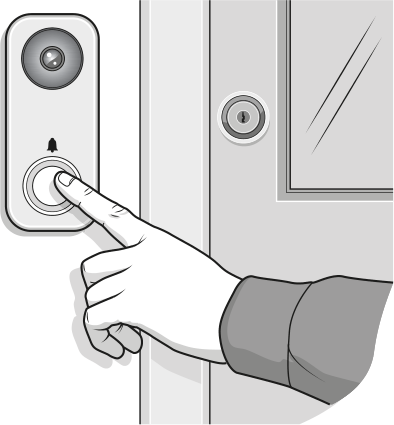
A video doorbell is attached to the front door of a house. The doorbell uses a motion sensor to detect when a visitor walks in front of the door. When the motion sensor is activated:
The digital camera in the doorbell starts recording a video.
A message is transmitted to a smartphone so that the person who lives in the house can watch the video.
The doorbell also has a button that can be pressed. When the button is pressed, a message is transmitted to a smartphone to play the doorbell sound.
The videos are stored on the doorbell’s internal secondary storage device and overwritten when the secondary storage device is full.
(a) The video doorbell can be considered an example of an embedded system. 2 marks
Identify two characteristics of the doorbell that suggest it is an embedded system.
1
2
(b) State whether the video doorbell is a monitoring system or a control system. 2 marks
Justify your choice.
Monitoring or control system
Justification
Show mark scheme
2(a) [2 marks]
1 mark each to max 2 : The doorbell only performs the specific tasks of motion detection/video recording/doorbell ringing The motion sensor and digital camera are built into the doorbell The CPU/memory/storage/software are all dedicated to this task only Only a dedicated microprocessor is required due to the limited processing requirements
2(b) [2 marks]
No mark for identification of monitoring or control 1 mark each to max 2 for justification: Monitoring: The turning on of the digital camera does not affect the input to the sensor/button The transmission of the data/video does not affect the input to the sensor/button The ringing of the doorbell does not affect the input to the button Control: Video doorbell does not only store the values from the motion sensor The data is processed, generating a signal to start the digital camera recording Button pressed/motion detected causes a signal to be sent over a network to the smartphone
2(c)(i) [2 marks]
1 mark each to max 2 : Current reading/data from motion sensor Current/recent video Instructions being executed Start-up/BIOS/boot-up instructions
2(c)(ii) [4 marks]
1 mark for each row: Statement The two types of logic gate that can be used to create solid NAND state devices NOR The number of transistors contained in each cell 2 The type of gate that can retain electrons without power floating The type of gate that allows or stops current from passing control through
2(c)(iii) [2 marks]
1 mark each to max 2 : Captured video is transmitted to buffer … video is transmitted from buffer to smartphone Store recent data in a buffer for the user to rewind … instead of storing everything in secondary storage Store readings from motion sensor … until the microprocessor can process them Store video from digital camera … before moving it to secondary storage
2(d) [3 marks]
1 mark each to max 3 : Data transmission to user’s smartphone will take longer … because there is more data to transmit The secondary storage device will fill faster … fewer videos will be able to be stored long-term // videos are overwritten more often
2(e)(i) [1 mark]
1 mark for: Continuous ordered flow of bits over a communication path
2(e)(ii) [2 marks]
1 mark each to max 2 : Real-time is direct from source whereas on-demand is pre- recorded/downloaded to view later Real-time cannot be re-watched, on-demand can be paused, re-watched etc. Real-time plays continually, on-demand downloads sections/blocks and cannot play until next section is downloaded
A computer game is being designed that users will be able to play using a virtual reality (VR) headset.
(a) Complete the description of the principal operation of a VR headset. 4 marks
A headset can have one or two ______ that output the image to
the user. The headset has speakers that output surround sound to give a realistic experience.
The user’s head movements are detected using a sensor.
This sensor is a ______ . The data is transmitted to a
microprocessor that analyses the data to identify the ______ of
movement. Some headsets use ______ that record the user’s
eye movements for analysis.
(b) The computer uses a buffer when transmitting data to the VR headset. 3 marks
Explain how a buffer is used when data is transmitted between the computer and the VR headset.
(c) The VR headset has Electrically Erasable Programmable Read Only Memory (EEPROM). 3 marks
Explain the benefits of using EEPROM instead of other types of Read Only Memory (ROM) in the VR headset.
Show mark scheme
2(a) [3 marks]
1 mark for each correctly completed statement: ( LCD) displays/screens/lenses gyroscope/accelerometer direction/speed digital cameras A headset can have one or two (LCD) displays/screens/lenses that output the image to the user. The headset has speakers that output surround sound to give a realistic experience. The user's head movements are detected using a sensor. This sensor is a gyroscope/accelerometer . The data is transmitted to a microprocessor that analyses the data to identify the direction/speed of movement. Some headsets use digital cameras that record the user's eye movements for analysis.
2(b)
1 mark each to max 3 : The buffer is used as a temporary store for data going to the headset Data is transferred into the buffer by the computer Data is retrieved from the buffer by the headset When the buffer is empty/full an interrupt is sent to the computer requesting more data/stopping further data being sent When the headset has enough data/needs more data, an interrupt is sent by the headset to the computer to stop sending data from buffer
2(c) [3 marks]
1 mark each to max 3 : EEPROM allows frequent/multiple read/write/erase operations … so the headset can take advantage of new features … without fully erasing the contents of the firmware in the headset first // can erase a particular byte or the whole EEPROM … without removing the chip(s)/firmware from the headset ... the contents of the firmware in the headset can be changed by the user without technical expertise Cheaper to manufacture so headset will be cheaper to purchase
2(d)(i) [3 marks]
1 mark each: Image is made of pixels and each pixel has one colour Each colour has a unique binary code Code for the colour of each pixel is stored in sequence
2(d)(ii) [2 marks]
1 mark each to max 2 : List of objects in the drawing A list that stores the command/description/equation required to draw each object Properties of each object e.g. the fill colour, line weight/colour
2(d)(iii) [3 marks]
1 mark each to max 2 : Dedicated connection to the headset // not sharing bandwidth Already fast connection that can transmit the data without slowing Video may already be a small file size and does not need further reduction Video is not saved so storage is not an issue in the headset
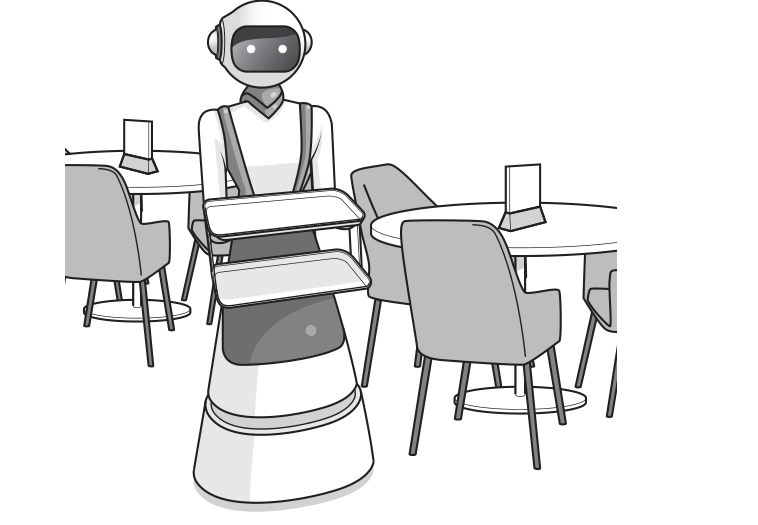
Robots are used to serve food and drink to customers at a restaurant.
(a) A robot navigates through the restaurant to the table it is serving. 2 marks
Complete the table by identifying two sensors that can be included in the robot and the purpose of each sensor in the navigation system.
| Sensor | Purpose of sensor in navigation system |
|---|---|
(b) The robot uses Artificial Intelligence (AI) to communicate with the customers. The customers speak to the robot to order their food and drinks. 3 marks
Explain how AI will be used in this part of the robot.
(c) The navigation system can be considered an example of a control system. 2 marks
Describe how feedback is used in a control system.
(d) The robot includes a touchscreen for the customer to make their payment. 4 marks
Describe the principal operation of a touchscreen.
(e) Program libraries were used when writing the robot’s software.
(i) State what is meant by a program library . 1 mark
(ii) Some program libraries include Dynamic Link Library (DLL) files. 4 marks
Describe the benefits of a programmer using a library with DLL files instead of using a library that does not include DLL files.
(f) The data from the robots is transmitted to a central computer using a wireless connection.
(i) Complete the table by identifying and describing two methods of data verification that can be used during data transfer. 4 marks
| Method | Description | |
|---|---|---|
| 1 | ||
| 2 |
(ii) Explain how encryption can protect the security of data during transmission. 2 marks
Show mark scheme
7(a) [2 marks]
1 mark for sensor and matching purpose to max 2 : Sensor Purpose of sensor in navigation system Pressure To detect if a table or other obstacle has been hit // to detect when food is put on/taken off the tray so it can move on Infra-red To detect if there is an obstacle in the way // to indicate that it has reached the desired table Sound To detect if someone is speaking so that it can use AI to decipher the speech and whether the robot is required to stop
7(b) [2 marks]
1 mark each to max 3 : e.g. Voice/speech recognition is used ... to identify if someone speaking The sound is recorded and analysed The audio recordings are compared to a database of words/sound waves ... to identify the word that has the highest probability of being said Natural language recognition is used Words are combined and compared to known sentences … programmed action(s) for matching sentence(s) are performed
7(c)
1 mark each to max 2 : Feedback ensures that a system operates within set criteria / constraints ... by enabling system output to affect subsequent system input ... thus allowing conditions to be automatically adjusted
7(d) [1 mark]
1 mark each to max 4 : Resistive: The space between the conductive layers is removed/the layers touch and a circuit is completed Capacitive: The electrical charge changes where the user pressed The point of contact is identified ... from the change in electrical field The software/microprocessor calculates the coordinates
7(e)(i)
1 mark for: Pre-written code/functions/routines that can be imported/called in another program
7(e)(ii) [4 marks]
1 mark each to max 4 : Maintenance not needed to be done by the programmer ... because the DLL is separate from program The calling program does not need recompilation by the programmer when a DLL file changes ... because the DLL file can be updated independently of the calling program … updates will apply to all programs that use the DLL file
7(f)(i) [4 marks]
1 mark for each correct method and 1 mark for corresponding description to max 4 : Method Description Parity byte An additional bit is added to make the number of 1s in the byte odd or even to match the parity. If a byte with an odd number of 1 bits is received when even parity is used, there is an error. Parity block Parity is calculated horizontally and vertically. A parity byte is created from the bits produced by the vertical parity check. This is sent with the data. The parity is re-checked when received and the position of an incorrect bit can be determined. Checksum A calculation is made from the data and the result transmitted with the data. The receiver repeats the calculation and compares the result with the value received. If the two are different, there is an error.
7(f)(ii) [2 marks]
1 mark each to max 2 : Encodes/scrambles data ... so if it is intercepted it cannot be understood Algorithm /key is required to decode the data
The Central Processing Unit (CPU) of the basic Von Neumann model for a computer system contains several special purpose registers.
(a) The Memory Data Register (MDR), Index Register (IX) and the Accumulator (ACC) are examples of special purpose registers. 4 marks
Identify two other special purpose registers and state their role in the CPU.
Special purpose register 1
Role
Special purpose register 2
Role
(b) Describe what is meant by the Immediate Access Store (IAS) in a computer system. 2 marks
(c) A computer has a single 2.1 GHz CPU.
(i) Describe how increasing the clock speed to 4 GHz can increase the performance of the computer. 1 mark
(ii) A second computer has a CPU with two 2.1 GHz cores. 5 marks
Explain why the second computer does not always run twice as fast as the computer with one 2.1 GHz CPU.
Show mark scheme
5(a) [4 marks]
1 mark for identification of the register and 1 mark for role ( max 2 for each register) • Program Counter (PC) • stores the address where the next instruction is to be read from • Memory Address Register (MAR) • stores the address of the memory location (or an I/O component) currently being read from or written to • Current Instruction Register (CIR) • holds the instruction currently being decoded and/or executed • Status Register • Contains bits which can be referenced individually and set or cleared depending on the operation e.g. overflow, underflow
5(b) [2 marks]
1 mark for each bullet point ( max 2 ) • Immediate Access Store holds all the data / instructions / programs currently in use • Immediate Access Store is volatile memory • Immediate Access Store has fast access times
5(c)(i) [1 mark]
1 mark for each bullet point ( max 1 ) • The CPU can now perform nearly twice as many F-E cycles per second • Instead of 2.1 billion F-E cycles per second, the CPU can now perform 4 billion FE cycles per second
5(c)(ii) [5 marks]
1 mark for each bullet point ( max 5 ) • Multiple cores introduce additional overheads • …because of the need for communication between cores • Software may not be designed for multiple cores… • …so one of the cores will be left idle • Memory access speed may not match speed of cores… • …so causing delay • The two computers may have more differences than just the cores • …one may have more RAM which allows faster multitasking • ...one may have a GPU • ...etc.
(a) Describe the principal operations of a 3D printer. 3 marks
(b) Describe the purpose of a temperature sensor within the 3D printer. 2 marks
(c) A 3D printer contains 1 GB of Dynamic RAM (DRAM) to store print data. 2 marks
State two advantages of the printer having Dynamic RAM instead of Static RAM (SRAM).
1
2
Show mark scheme
7(a) [3 marks]
1 mark for each bullet point ( max 3 ) Generic mark points: • Additive manufacturing • Uses a digital 3D model or a Computer Aided Design (CAD) (file) • Builds up the model one layer at a time • ...starting from the bottom • ...using x, y and z co-ordinates • The material is fused / cured together layer by layer Specific mark points: Fused Deposition Modelling (FDM) • Material is heated and pushed through nozzle / extruder Stereolithography (SLA) • Photosensitive liquid resin is exposed to a UV-laser beam Digital Light Processing (DLP) • Uses liquid plastic resin melted with arc lamps Selective Laser Sintering (SLS) • Uses a laser to form objects from powdered material
7(b) [2 marks]
1 mark for each bullet point ( max 2 ) • To prevent overheating // ensure material is hot enough • ...by identifying the temperature of the object (being printed) • ...by identifying the temperature of the material being used
7(c) [2 marks]
1 mark for each bullet point ( max 2 ) • Dynamic RAM has lower cost per unit • A fast access speed is not needed • Higher bit density // more data can be stored per chip
(a) Explain the importance of feedback in a control system. 2 marks
(b) Give one example of an embedded system and explain why it is an example of an embedded system. 3 marks
Example
Explanation
Show mark scheme
9(a) [2 marks]
One mark for each bullet point ( max 2 ) • Feedback ensures that a system operates within set criteria / constraints • ...by enabling system output to affect (subsequent) system input • ...thus allowing conditions to be automatically adjusted
9(b) [3 marks]
One mark for each reason to max 3 to match the example given • Dedicated to one task applied to example • Does not require much processing power applied to example • Built into a larger system applied to example • Contains firmware that cannot be easily updated applied to example • The system does not have its own operating system • An embedded system must contain a processor, memory and an I/O capability // Dedicated hardware
A factory makes chocolate bars.
The factory uses a conveyor belt that moves the products from one stage of production to the next stage.
(a) An automated system counts the number of chocolate bars made at the end of production. 1 mark
The system includes a sensor positioned above the conveyor belt.
Identify one appropriate type of sensor that can be used.
(b) A second automated system removes chocolate bars with an incorrect weight from the production line. 2 marks
Describe the role of an actuator in this second system.
(c) The factory has many different machines with embedded systems.
(i) Identify two features of embedded systems. 2 marks
1
2
(ii) Identify one drawback of embedded systems. 1 mark
Show mark scheme
1(a) [1 mark]
1 mark for: • infra-red / proximity (sensor)
1(b) [2 marks]
1 mark for each bullet point ( max 2 ) • Actuator generates a signal / causes an action / converts electrical energy into a mechanical force • ... to push an arm // to open a trap door // to pick up the chocolate bar with the incorrect weight
1(c)(i) [2 marks]
1 mark for each feature ( max 2 ) • Dedicated to a single task // limited number of functions • Built into a larger system // integrated into a larger system • An embedded system must contain a processor, memory and an I/O capability // Dedicated hardware
1(c)(ii) [1 mark]
1 mark for each bullet point ( max 1 ) • Difficult to change / update the firmware by the user // Difficult to upgrade devices to take advantage of new technology • Cannot be easily adapted for another task • Troubleshooting faults/upgrading is a specialist task • Devices are often thrown away rather than repaired as difficult to upgrade or repair
A computer has an Operating System (OS).
(a) State one purpose of the Operating System. 1 mark
(b) The Operating System has utility software. 3 marks
The purpose of some utility software is to improve security.
Identify one example of utility software that is not intended to improve security.
Explain why this software is needed.
Utility software
Explanation
(c) An optical disc reader/writer is connected to the computer.
(i) Give the name of one port that can provide a connection for the optical disc reader/writer. 1 mark
(ii) Describe the roles of the address bus, the data bus and buffers in the process of writing data to the optical disc reader/writer. 3 marks
Show mark scheme
8(a) [1 mark]
1 mark for each bullet point ( max 1 ) • To hide the complexities of the hardware from the user • To provide a platform for software to run • To provide a user interface
8(b) [3 marks]
1 mark for the name of the utility software 2 marks for the explanation • Defragmentation software • … because over time saving and deleting of small files fragments the disk • ... the software makes (individual) files contiguous • … so access time to the files is improved • … because head movement is reduced • Disk contents analysis/disk repair software • … to identify and mark bad sectors • ... to restore corrupted files • ... to recover lost data (due to hardware failure) • File compression • … to reduce the size of files • ... which saves storage and memory space // by example • ... and reduces transmission time // by example • Disk formatter • … to prepare a disk for use // set up the file system • ... to partition the disc • ... to delete all the data from the disc
8(c)(i) [1 mark]
1 mark for each bullet point ( max 1 ) • USB / Universal Serial Bus • HDMI
8(c)(ii) [3 marks]
1 mark for each component ( max 3 ) Buffers • A buffer temporarily holds data until it is ready to be transmitted to the device Address Bus • The address of the data to be written to the device (in RAM) is carried on the address bus Data Bus • All data to be written to the device / buffer is carried on the data bus
A laptop computer has Static RAM (SRAM).
A virtual reality headset and a laser printer are connected to the laptop.
(a) Explain why Static RAM is used in the laptop instead of Dynamic RAM. 2 marks
(b) Identify two reasons for using Electrically Erasable Programmable ROM (EEPROM) in a virtual reality headset. 2 marks
1
2
(c) Describe how the laser printer makes use of a buffer. 4 marks
(d) Identify one port that could be used to connect the virtual reality headset to the laptop. 3 marks
Justify your choice.
Port
Justification
Show mark scheme
7(a) [2 marks]
1 mark for each bullet point ( max 2 ). • Static RAM has faster access time • …because it does not need to be refreshed • …used on the CPU for improvement of CPU cache speed • Static RAM has lower
7(b) [2 marks]
1 mark for each bullet point ( max 2 ) • EEPROM allows frequent / multiple read / write / erase operations • …which means that the contents of the firmware in the headset can be changed easily • …without fully erasing the contents of the firmware in the headset first
7(c) [4 marks]
1 mark for each bullet point ( max 4 ) • The print instructions and data are sent by the laptop to a buffer (at laptop speed) • The data is transferred from the buffer to the printer (at printer speed) • …allowing user to continue using the laptop // and allowing processor to continue processing • …instead of waiting for relatively slower printer • When the buffer is empty an interrupt is sent to the laptop • …requesting more data
7(d) [3 marks]
1 mark for naming a correct port 2 marks for matching justification • USB • …has fast data transfer speeds for data (to the headset) • …is a universal/popular cable // universal standard • HDMI • …allows video and audio to be transferred (on the same cable) • …convenience of HDMI as no need for two cables
A computer system is designed using the basic Von Neumann model.
Registers and buses are components in the Von Neumann model.
(a) (i) Identify three other components in the Von Neumann model of a computer system. 3 marks
Do not include registers or buses in your answers.
1
2
3
(ii) Identify two differences between special purpose registers and general purpose registers. 2 marks
1
2
(b) The following incomplete table contains steps of the Fetch‑Execute (F‑E) cycle and their descriptions. 4 marks
| Complete the table by writing the missin missing descriptions. | ng steps using register transfer notation and the |
|---|---|
| Step | Description |
| ______ | The address in PC is incremented. |
MDR [[MAR]] |
______ |
MAR [PC] |
______ |
| ______ | The contents of MDR are copied into CIR. |
(c) Interrupts can be caused by software programs or hardware devices. 1 mark
State one cause of a software interrupt.
(d) The following statements describe the stages that the CPU performs when an interrupt is detected. 3 marks
There are three missing statements.
Write the letter of the missing statements from the table in the correct place to complete the description.
1 At the end of each Fetch‑Execute (F‑E) cycle, the processor checks if an interrupt flag is set.
2
3 If the interrupt priority is high enough, the processor saves the current contents of the registers.
4
5 When servicing of the interrupt is complete, the processor restores the registers.
6
| Letter | Stage |
|---|---|
| A | The address of the Interrupt Service (ISR) handling routine is loaded into the Program Counter (PC). |
| B | Lower priority interrupts are re‑enabled. |
| C | The device causing the interrupt transfers data to the CPU. |
| D | The processor identifies the source of the interrupt and checks the priority of the interrupt. |
| E | The ISR is incremented. |
Show mark scheme
9(a)(i) [3 marks]
1 mark for each bullet point ( max 3 ). • Control unit (CU) • Arithmetic and Logic Unit (ALU) • Immediate Access Store (IAS) • (System clock)
9(a)(ii) [2 marks]
1 mark for each bullet point ( max 2 ). • Special purpose registers hold the status of a program whereas general purpose registers hold the temporary data while performing operations. • Special purpose registers are specialised for a specific use, whereas general purpose registers are used for any purpose. • General purpose registers can be used by most instructions, whereas special purpose can only be used by certain instruction
9(b) [4 marks]
1 mark for each correct answer (shaded cells) Step Description The address in PC is incremented. PC [PC] + 1 The data in the location pointed to by the MAR MDR [[MAR]] is copied to the MDR. The contents of PC are copied to the MAR. MAR [PC] The contents of MDR are copied into CIR. CIR [MDR]
9(c) [1 mark]
1 mark for an appropriate example. Examples: • Division by zero • Runtime error • Out of memory bounds • Program requesting an external device / input • Buffer overflow
9(d) [3 marks]
1 mark for each letter in the correct position (2, 4 and 6)
A networked closed‑circuit television (CCTV) system in a house uses sensors and cameras to detect the presence of a person. It then tracks the person and records a video of their movements.
Data from the CCTV cameras is transmitted to a central computer.
(a) This computer has both Read Only Memory (ROM) and Random Access Memory (RAM).
(i) Describe the contents of the ROM in the central computer. 2 marks
(ii) The central computer has Dynamic RAM (DRAM). 2 marks
Identify two advantages of using DRAM instead of Static RAM (SRAM).
1
2
(b) The central computer stores the video files on secondary storage. 4 marks
Describe two reasons why magnetic storage is more appropriate than solid state storage for this computer.
1
2
(c) The CCTV system uses Artificial Intelligence (AI) to identify the presence of a person in the house and to track their movements. 3 marks
Describe how AI is used in this system.
(d) The CCTV cameras are connected to a network and transfer their data wirelessly to the central computer.
(i) Each device on the network has an IP address. 5 marks
Complete the description of IP addresses.
An IPv4 address contains ______ groups of digits. Each group is
represented in ______ bits and the groups are separated by full stops.
An IPv6 address contains ______ groups of digits. Each group is
represented in ______ bits. Multiple groups that only contain zeros
can be replaced with a ______ .
(ii) The network makes use of subnetting. 4 marks
Describe two benefits of subnetting a network.
1
2
Show mark scheme
4(a)(i)
1 mark each to max 2 Stores the bootstrap program // start-up instructions for the central computer // BIOS Stores the start-up instructions for the CCTV system/cameras // firmware for CCTV Stores the kernel of the Operating System // stores parts of the Operating System
4(a)(ii) [2 marks]
1 mark each to max 2 Costs less per unit Higher storage density Simple design – uses fewer transistors
4(b) [3 marks]
1 mark for reason, 1mark for application/justification The computer will have a large number of read/write operations because it is working all the time .. magnetic storage has more longevity Magnetic storage costs less per storage unit … videos are large files and therefore very large storage capacity is required
4(c) [5 marks]
1 mark each to max 3 Examples: Uses image recognition Monitors every image taken to identify matching images/shapes/features to a 'person' … … starts recording to secondary storage/permanently when a person is identified System identifies direction of movement of person and uses this to decide where/how to move the camera/record System identifies other cameras to start recording based on direction of movement
4(d)(i)
1 mark for each term An IPv4 address contains 4 groups of digits. Each group is represented in 8 bits and the groups are separated by full stops. An IPv6 address contains 8 groups of digits. Each group is represented in 16 bits. Multiple groups that only contain zeros can be replaced with a :: // double colon .
4(d)(ii) [4 marks]
1 mark for identification, 1mark for expansion e.g. Reduce amount of traffic in a network // improve network speed Data stays in its subnet so it does not travel as far Improves network security .. so that not all devices can access all areas of the network Allows for easier maintenance … because only one subnetwork may need taking down/changing while the rest of the network can continue
A student has purchased a new laptop.
(a) The laptop is designed using the Von Neumann model for a computer system. 2 marks
Identify two types of signal that a control bus can transfer.
1
2
(b) Describe two ways the hardware of a laptop can be upgraded to improve the performance and explain how each upgrade improves the performance. 4 marks
1
2
(c) Peripherals are connected to the laptop using ports.
(i) A printer is connected to a Universal Serial Bus (USB) port. 1 mark
Describe how data is transmitted through a USB port.
(ii) A monitor is connected to the laptop using a different type of port. 1 mark
Identify one other type of port that can be used to connect the monitor.
(d) The laptop has systems software.
(i) Describe how the Operating System (OS) manages processes in the computer. 5 marks
(ii) Describe the purpose of utility software in a computer. 2 marks
Show mark scheme
5(a) [2 marks]
1 mark each to max 2 Examples: Interrupt Timing Read Write
5(b) [4 marks]
1 mark for description; 1 mark for corresponding explanation Examples Increase number of cores Each core can independently carry out a process at the same time // so that more instructions are performed in parallel Increase RAM capacity ... allowing more applications to reside in memory at the same time, saving disk access times Increase cache memory More data can be stored in fast access so less time is spent accessing from RAM Increase clock speed More Fetch-Decode-Execute (FDE) cycles can run each second / per unit time
5(c)(i) [1 mark]
1 mark for a correct answer 1 bit is transferred at a time Can be synchronous or asynchronous earlier versions are half-duplex USB-3 is full duplex and
5(c)(ii) [1 mark]
1 mark for identification of a suitable port Examples HDMI DisplayPort
5(d)(i) [5 marks]
1 mark each to max 5 Manages the scheduling of processes // decides which order to run processes Manages which resources the processes require … such as allocating memory Enables processes to share data Prevents interference between processes // resolution of conflicts Handles the process queue It allows multi-tasking / multi-processing ... by ensuring fair access, handling priorities and handling interrupts
5(d)(ii) [2 marks]
1 mark each to max 2 To help users to set-up / configure / analyse / optimise / maintain the computer ... ... by for example, making memory allocation more efficient ... by for example, checking the system for faults
A mobile telephone is used to record a video.
(a) The mobile telephone has a touchscreen. There are different types of touchscreen. 5 marks
Complete the description of the principal operation of touchscreens.
A ______ touchscreen has two layers. When the user touches
the screen, the layers touch and a ______ is completed.
A ______ touchscreen has several layers. When the top layer
is touched, there is a ______ in the electric current.
A microprocessor identifies the ______ of the touch.
(b) The mobile telephone uses a built-in digital camera to record the video. 3 marks
The digital camera automatically focuses on the faces of people.
Explain how Artificial Intelligence (AI) is used by the camera to automatically focus on the faces of people.
(c) The video includes a sound recording.
(i) Describe how sound is represented in a computer. 3 marks
Show mark scheme
3(a) [3 marks]
1 mark for each term Resistive Circuit Capacitive Change Coordinates A resistive touchscreen has two layers. When the user touches the screen, the layers touch and a circuit is completed. A capacitive touchscreen has several layers. When the top layer is touched there is a change/increase/decrease in the electric current. A microprocessor identifies the coordinates of the touch.
3(b)
1 mark each to max 3 Examples: Scans the scene in real time Identifies if there are faces in the image Uses facial recognition ... uses image recognition ... takes each frame individually ... analyses the pixels ... stores pattern for a face ... looks for patterns that match/come close to the pattern for a face Camera focuses on the pattern identified
3(c)(i) [4 marks]
1 mark each The amplitude is recorded a set number of times a second Each (instance of an) amplitude is given a corresponding binary number The binary number (of each amplitude) is saved in sequence
3(c)(ii) [4 marks]
1 mark each; max 2 for rate and max 2 for resolution Sampling rate There are smaller 'gaps' in the sound wave // sound is recorded more often Digital waveform is closer to the analogue waveform The quantisation errors are smaller Sampling resolution There are more bits per sample // a wider range of amplitudes can be stored Each binary amplitude /note (in the digital recording) is closer to the analogue amplitude /note Digital waveform is closer to the analogue waveform The quantisation errors are smaller
Many modern televisions are examples of embedded systems.
(a) Explain why these televisions are embedded systems. 2 marks
(b) Embedded systems use Electrically Erasable Programmable ROM (EEPROM). 2 marks
Describe one benefit of using EEPROMs in an embedded system.
Show mark scheme
9(a) [2 marks]
1 mark for each bullet point ( max 2 ): • the embedded system is built into / integrated into the TV • combination of hardware and software designed for a specific function • The system is not easily changed /updated by the TV owner
9(b) [2 marks]
1 mark for each benefit and 1 mark for corresponding expansion ( max 2 ). For example: • no additional equipment is needed to change • ... enables firmware updates by non-technical users • can be erased and reprogrammed several times • ... so firmware can be updated • ... can erase a particular byte or the whole EEPROM • possible to reprogram / update • ... without removing it from the device
Show mark scheme
2(a)(i) [1 mark]
–106
2(a)(ii) [1 mark]
96
2(a)(iii) [2 marks]
1 mark for each bullet point: • 149 decimal • 0001 0100 1001
2(b) [1 mark]
1101 0010
The relational database ASTRONOMY is used to store data about telescopes, the companies that
own the telescopes and the photographs taken by the telescopes.
The database has these three tables:
  COMPANY(TelephoneNumber, CompanyID, CompanyName)
  PHOTOGRAPH(PhotoID, TelescopeID, DateTaken, TimeTaken, Elevation)
  TELESCOPE(TelescopeID, CompanyID, SerialNumber)
(a) Complete the following table by writing the correct answer for each item. 3 marks
| Item | Answer |
|---|---|
a suitable field for the primary key inCOMPANY |
|
a candidate key inTELESCOPE |
|
the degree of relationship betweenTELESCOPE andPHOTOGRAPH |
(b) A Database Management System (DBMS) has several features. 1 mark
Identify the feature that describes the relationship between data and its structure.
(c) Complete the SQL script to return the total number of telescopes owned by the company whose ID begins with HW . 4 marks
SELECT ______ ( ______ )
FROM TELESCOPE
WHERE ______ LIKE ______ ;
Show mark scheme
2(a) [3 marks]
1 mark for each correct answer. Item CompanyID a suitable field for the primary key in COMPANY SerialNumber // a candidate key in TELESCOPE TelescopeID the degree of relationship between 1:M / 1 to many TELESCOPE and PHOTOGRAPH
2(b) [1 mark]
Logical schema
2(c) [4 marks]
1 mark for each correctly completed missing part: SELECT COUNT ( TelescopeID ) FROM TELESCOPE WHERE CompanyID LIKE 'HW%' ;
2(d) [2 marks]
1 mark for each bullet point: • ALTER TABLE PHOTOGRAPH • ADD Resolution TEXT; ALTER TABLE PHOTOGRAPH ADD Resolution TEXT / VARCHAR(11);
2(e) [2 marks]
1 mark for each correctly completed term; The bit depth of a bitmap image is the number of bits that are used to store each pixel. Metadata about the image is stored in the header of the file.
2(f) [2 marks]
1 mark for each bullet point ( max 2 ): • allows the user to enter criteria • searches for the data that meets the entered criteria • organises the results to be displayed to the user
A computer has hardware and software.
(a) The hardware includes different types of memory.
(i) Complete the description of computer memory. 5 marks
Random Access Memory (RAM) and Read Only Memory (ROM) are both examples of
______ memory.
One item that is stored in RAM is ______ .
One item that is stored in ROM is ______ .
RAM can be either Static RAM (SRAM) or Dynamic RAM (DRAM).
SRAM uses transistors arranged as ______ .
DRAM uses transistors and ______ .
(ii) Explain the difference between Programmable ROM (PROM), Erasable Programmable ROM (EPROM) and Electrically Erasable Programmable ROM (EEPROM). 3 marks
Show mark scheme
2(a)(i)
1 mark for each correct term. Random Access Memory (RAM) and Read Only Memory (ROM) are both examples of primary memory. One item that is stored in RAM is currently running software/data/part of OS . One item that is stored in ROM is the start-up/boot-up instructions/BIOS . RAM can be either Static RAM (SRAM) or Dynamic RAM (DRAM). SRAM uses transistors arranged as flip-flops/latches. DRAM uses transistors and capacitors .
2(a)(ii) [3 marks]
1 mark per bullet point to max 3 PROM can be set once, EPROM and EEPROM can be overwritten multiple times. EPROM needs to be removed from device EEPROM can be erased in situ. EPROM and can be erased using UV light, EEPROM can be erased using voltage // is flash storage . EPROM must be entirely erased before rewriting, EEPROM does not have to be entirely erased before rewriting.
2(b) [5 marks]
1 mark per bullet point to max 5 The hard disk has (one or more) platter/plate/disk Each surface of the platter/disk is (ferrous oxide which is) capable of being magnetised The platters/disks are mounted on a (central) spindle The entire mechanism is contained inside a sealed (aluminium) box. The disks are rotated (at high-speed) (Each surface of the disk) has a read/write head mounted on an arm (positioned just above the surface) Electronic circuits control the movement of the arm (and hence the heads) The surface of the platter/disk is divided into concentric tracks / circles The surface of the platter/disk is divided into sectors One track in one sector is the basic unit of storage called a block The data is encoded as a magnetic pattern for each block When writing to disk, a variation in the current in the head produces a variation in magnetic field on the disk When reading from disk, a variation in magnetic field produces a variation in current through the head
2(c)(i) [4 marks]
1 mark for each correct row. Gate Input 1 Input 2 AND 1 1 0 0 NAND 0 1 1 0 0 1 XOR 1 0 NOR 0 0
2(c)(ii) [3 marks]
1 mark per bullet point A NAND B B XOR C OR ( A NAND B ) OR ( B XOR C )
A car has several features.
(a) One feature is a lane detection system. This system monitors the lines on either side of the lane. If the car gets too close to one line, the system automatically moves the car away from the line. 2 marks
Explain why the lane detection system is an example of an embedded system.
(b) Two other features: 2 marks
record the number of miles travelled in the current journey, from when the engine is turned on to when it is turned off
record the total number of miles the car has travelled since it was built.
Identify the data that will be stored in the primary and secondary storage of the car for these two features.
Primary
Secondary
(c) The car has a resistive touchscreen for the user to select options. 1 mark
| ck (3) one box in each row to show whether ea true or false. | ach statement a | about a resistive t |
|---|---|---|
| Statement | True | False |
| The screen always has five different layers | ||
| A processor determines the horizontal and vertical coordinates of the point of contact |
||
| The touchscreen will work if any object touches the screen |
Show mark scheme
2(a) [2 marks]
1 mark per point to max 2 The lane detection system is built into / integrated into the car The lane detection system only performs one task The lane detection system is not easily changed/updated by the car owner
2(b)
1 mark for primary e.g. Miles travelled in the current journey , before the engine is turned off 1 mark for secondary e.g. Total miles travelled since the car was built // miles for most recent journey after engine switched off
2(c) [1 mark]
1 mark for all correct ticks Statement True False The screen always has five different layers A processor determines the horizontal and vertical coordinates of the point of contact The touchscreen will work if any object touches the screen
Andy likes to play computer games.
(a) Andy uses several input devices to play the games. These include a keyboard and a microphone. 3 marks
Describe the principal operation of a microphone.
(b) Andy plays some of the computer games over the internet. He has several devices that connect wirelessly to the router in his house.
(i) Identify the topology of Andy’s home network. Justify your choice. 2 marks
Topology
Justification
(ii) The router has a wireless access point (WAP) to allow the devices to connect wirelessly. 3 marks
Identify three functions of the router in Andy’s network.
1
2
3
Show mark scheme
3(a)
1 mark for each bullet point to max 3 The microphone has a diaphragm / ribbon • The incoming sound waves cause vibrations of the diaphragm • … causing a coil to move past a magnet // causing a magnet to move • past a coil (dynamic microphone) // changing the capacitance (condenser microphone) // deforms the crystal (crystal microphone) An electrical signal is produced •
3(b)(i) [2 marks]
1 mark for identification of star topology 1 mark for justification Devices are connected directly to the router independently // all devices are only connected to the router
3(b)(ii) [3 marks]
1 mark for each correct function to max 3 To receive packets from devices or the Internet • To forward / route packets to the destination • To find the destination of the packet • To assign / allocate private IP addresses to devices on LAN • To store / update / maintain a routing table • To find the most efficient path to the destination • To maintain a table of MAC and IP addresses •
Kiara has a washing machine and a refrigerator.
(a) She has an embedded system in her washing machine. 2 marks
Describe what is meant by an embedded system, using the washing machine as an example.
(b) The washing machine’s embedded system makes use of both Random Access Memory (RAM) and Read Only Memory (ROM). 2 marks
State the purpose of RAM and ROM within the washing machine’s embedded system.
RAM
ROM
(c) The temperature in her refrigerator must be kept between 4 and 6 degrees Celsius. 2 marks
The microprocessor in the refrigerator turns on the cooling if the temperature is too high, and turns off the cooling if the temperature is too low.
Explain why the system in the refrigerator is a control and not a monitoring system.
Show mark scheme
5(a) [2 marks]
1 mark per bullet point to max 2 Definition: Microprocessor/microcontroller within a larger system // • microprocessor/microcontroller that performs one specific task Example: e.g. Embedded system in washing machine only controls the • programs for the washing cycle // it is part of the washing machine but does not perform any other function within it
5(b) [2 marks]
1 mark for RAM, 1 mark for ROM RAM: Store the choices/wash program the user has entered // stores the data • read from the sensors // stores the time left in the program // by example ROM: Store the start-up instructions (for the washing cycles) •
5(c)
1 mark per bullet point The system uses feedback • The system causes the temperature to change // produces an action •
Kiara has a washing machine and a refrigerator.
(a) She has an embedded system in her washing machine. 2 marks
Describe what is meant by an embedded system, using the washing machine as an example.
(b) The washing machine’s embedded system makes use of both Random Access Memory (RAM) and Read Only Memory (ROM). 2 marks
State the purpose of RAM and ROM within the washing machine’s embedded system.
RAM
ROM
(c) The temperature in her refrigerator must be kept between 4 and 6 degrees Celsius. 2 marks
The microprocessor in the refrigerator turns on the cooling if the temperature is too high, and turns off the cooling if the temperature is too low.
Explain why the system in the refrigerator is a control and not a monitoring system.
Show mark scheme
5(a) [2 marks]
1 mark per bullet point to max 2 Definition: Microprocessor/microcontroller within a larger system // • microprocessor/microcontroller that performs one specific task Example: e.g. Embedded system in washing machine only controls the • programs for the washing cycle // it is part of the washing machine but does not perform any other function within it
5(b) [2 marks]
1 mark for RAM, 1 mark for ROM RAM: Store the choices/wash program the user has entered // stores the data • read from the sensors // stores the time left in the program // by example ROM: Store the start-up instructions (for the washing cycles) •
5(c)
1 mark per bullet point The system uses feedback • The system causes the temperature to change // produces an action •