6.1 Data Security
AS Level · 21 questions found
What this topic covers
Section titled “What this topic covers”- Difference between security, privacy and integrity of data
- Security measures: user accounts, passwords, digital signatures, biometrics, firewall, anti-virus, encryption
- Threats: malware (virus, spyware), hackers, phishing, pharming
- Methods to restrict threats; encryption and access rights for data security
Past paper questions
Section titled “Past paper questions”One ethical consideration for a student connecting their personal computer to the school network is the risk of spreading malware on the network.
(a) Viruses and pharming are examples of malware. 2 marks
Explain what is meant by a virus and pharming.
Virus
Pharming
(b) Give three other ethical considerations for a student using their personal computer to connect to the school network. 3 marks
1
2
3
(c) Describe two social impacts of students using Artificial Intelligence (AI) to complete their homework. 4 marks
1
2
Show mark scheme
8(a) [2 marks]
1 mark for each correct explanation, max 2 marks Virus: Malicious program/software that replicates/copies itself and deletes/alters files/data stored on a computer Pharming: Malicious code/software installed on a computer which redirects user to a fake website to obtain personal data
8(b) [3 marks]
1 mark per bullet point, max 3 marks e. g. • Students should consider privacy issues • Students should not make inappropriate use of social networking // Students should not engage in cyberbullying • Students should not copy work that is not their own • Students should abide by the school rules/guidelines for accessing the network • Students should only use the school network for legitimate purposes • Students should not hack / crack other computers
8(c) [4 marks]
1 mark per bullet point, max 4 marks e. g. Negative Impacts • If students use AI to shortcut learning, they may miss out on developing reasoning and problem-solving skills // Students may not be learning anything // It could lead to a decline in specific skills • It could have negative impacts on student communication // heavy reliance on AI may limit opportunities for collaboration, teamwork, and face-to-face communication • Emphasises the digital divide// some students may not have access to the technology • The AI answer might not be correct leading to mis-information • Increased screen time and isolation could contribute to anxiety or loneliness Positive Impacts • Students given additional support may do better • Pupils who struggle in traditional settings may gain self -esteem through AI-assisted learning at their own pace Long-Term Impacts • Protection of intellectual property // ethical issues and considerations • Schools may need to redesign curricula and/or assessment to integrate AI
A banker stores personal data on their work computer.
(a) The banker needs to transfer confidential data across the internet. 3 marks
Identify and describe one method of restricting the risks posed by an unauthorised person intercepting the data whilst it is being transferred across the internet.
Method
Description
(b) The banker receives confidential data across the internet. The data includes a digital signature. 5 marks
Explain how a digital signature can make sure the data has not been changed during transmission.
(c) The data that is transferred can also be verified using a checksum. 3 marks
Explain how data can be verified using a checksum.
Show mark scheme
7(a) [3 marks]
1 mark for a correct method: 1 mark each to max 2 for a corresponding description Method: Encryption Description: • Data is encoded/scrambled using a key to create cipher text • if intercepted it cannot be understood • without being decrypted using a key
7(b) [5 marks]
1 mark each to max 5 • The sender hashes the document / message • to produce a digest • The sender encrypts the digest to create the digital signature • The message and the signature are sent to the banker / receiver • The receiver decrypts the signature to reproduce the digest • The receiver uses the same hashing algorithm on the document received to produce a second digest • The receiver compares this digest with the one from the digital signature • If both of the receiver’s digests are the same the document has not changed
7(c) [3 marks]
1 mark each to max 3 • The data is put through an algorithm to create a checksum value • The data and checksum are sent to the receiver • The receiver performs the same algorithm on the data • if both checksums match the data is verified
A program is written in a high-level language by a team of three programmers using an Integrated Development Environment (IDE).
(a) Describe how the programmers can use the debugging features of a typical IDE during the development of the program. 4 marks
(b) The programmers created a new program library whilst developing the program. 3 marks
Describe the benefits to the programmers of creating a program library.
(c) The file containing the final program code will be sent by email for beta testing. 3 marks
Identify one security method that can be used to protect the program code from unauthorised access during email transfer.
Explain how your chosen method protects the program code.
Security method
Explanation
Show mark scheme
4(a) [4 marks]
1 mark for each bullet point ( max 4 ) e.g. • Single stepping • Run the program one line at a time • … and check the variable contents / program flow // show the effect of each line of code • Set breakpoints • … run the code up to a set line • ... and then check the status • Variable/report watch window • … view how the data changes as the program is running
4(b) [3 marks]
1 mark for each bullet point ( max 3 ) e.g. • Subroutines can be shared / reused • … between team members who are working independently • … without having to rewrite/re-test them which saves the programmers’ time • A program library provides continuity between programs/programmers • Individual programmers can contribute their specialisms to the library // Individual programmers can use the specialisms of others
4(c) [3 marks]
1 mark for the security method. 2 marks for explanation Security method: Encryption Explanation • File contents are converted to cipher text • If intercepted the data cannot be understood without the decryption key
A bank allows customers to access their accounts using an application that they can download onto a device such as a smartphone.
(a) The system that allows customers to access their accounts using the application is a client-server model. 4 marks
Describe the roles of the different devices in this model.
(b) The bank wants to protect the integrity of its data while transferring the data to other banks. 5 marks
Parity check is one example of data verification.
Complete the description of parity check when Computer A is transmitting data to Computer B.
Computer A and Computer B agree on whether to use
parity. Computer A divides the data into groups of ______ . The
number of 1s in each group is counted. If the agreed parity is
and the group has an even number of 1s, a parity bit of 1 is appended, otherwise a parity bit
of 0 is appended.
In a parity ______ check the bytes are grouped together, for
example in a grid. The number of 1s in each column (bit position) is counted. A bit is assigned
to each column to make the column match the parity. These parity bits are transmitted with
the data as a parity ______ .
(c) The bank also needs to keep its customers’ data private and secure.
(i) The bank’s network has a firewall. 3 marks
Explain how a firewall can help protect the customers’ data.
(ii) Customers need to use biometric authentication to access their accounts. 4 marks
One biometric authentication method is facial recognition.
Facial recognition uses Artificial Intelligence (AI).
Describe how AI is used in facial recognition.
Show mark scheme
5(a) [4 marks]
1 mark each: Identification of server in the bank scenario Description e.g. Receives requests, processes the requests Identification of client in bank scenario Description e.g. Sends request to the server, waits and outputs the response
5(b) [5 marks]
1 mark for each correctly completed term: odd or even 7-bits odd block byte Computer A and Computer B agree on whether to use odd or even parity. Computer A divides the data into groups of 7-bits . The number of 1s in each group is counted. If the agreed parity is odd and the group has an even number of 1s a parity bit of 1 is appended, otherwise a parity bit of 0 is appended. In a parity block check the bytes are grouped together, for example in a grid. The number of 1s in each column (bit position) is counted. A bit is assigned to each column to make the column match the parity. These parity bits are transmitted with the data as a parity byte .
5(c)(i) [3 marks]
1 mark each to max 3 : Compares all incoming and outgoing transmissions ... against set criteria/whitelist/blacklist Blocks all transmissions that do not meet rules Blocks data entering from specific ports Blocks unauthorised/unknown internal software transmitting data
5(c)(ii) [4 marks]
1 mark each to max 4 : e.g. Captures an image of the face Uses image recognition Trained to identify the features of a face in an image … using a large number of images Analyse images for facial features Uses the probability of a match
An assessment board scans exam papers and stores the digitised papers on a server. Exam markers download the digitised papers to mark. The exam markers then upload the mark for each paper.
(a) The assessment board needs to make sure the data stored on the server is secure.
(i) Authentication methods can help to protect the server against hackers. 3 marks
Identify one other security measure that helps to protect the server from hackers.
Describe how the security measure works.
Security measure
Description
(ii) Identify one security measure that helps to protect the data when it is being transmitted to its destination. Describe how the security measure works. 3 marks
Security measure
Description
Show mark scheme
3(a)(i)
1 mark for security measure 1 mark each to max 2 for how the chosen measure works: Firewall Checks incoming connections ... against criteria Blocks data from entering specific ports Blocks data that does not meet whitelist that meets blacklist Proxy server Prevents devices accessing the web server directly Intercepts any requests Forwards the request using its own IP address Screens returning data before sending it to the user
3(a)(ii) [3 marks]
1 mark for security measure 1 mark each to max 2 for description of the chosen measure: Encryption Encodes/scrambles data ... so if it is intercepted it cannot be understood Algorithm/key is required to decode the data
3(b) [4 marks]
1 mark for characteristic 1 mark for description of application to examination software: Thin-client characteristic Description of use in this software Data is not stored on the Exam papers are stored on the server and client computer not on the examiner’s computer // exam papers are not permanently stored on the examiners’ computers Client computer is reliant on Examiners cannot mark if their device access to server cannot access the server / the server ‘goes down’ The marking software will not operate Client computer heavily without network/internet access reliant on network/internet connection Client computer requires few Examiners can use devices with low local resources/memory resources and the marking software will still function Client computer performs The marking software transmits requests, minimal functions/processes the server responds and sends the response to the user
3(c)(i) [2 marks]
1 mark each to max 2 : Receives packets from internet Analyses the destination IP address of each packet Forwards the packet towards its destination ... using the routing table Maintains/updates the routing table Finds the most efficient route to the destination
3(c)(ii) [1 mark]
1 mark each to max 2 : The PSTN consists of many different types of communication lines … therefore the digital data may need to be converted into a different form/analogue signal Data is transmitted in both directions at the same time // duplex data transmission Using a PSTN the communication passes through different switching centres/ISPs
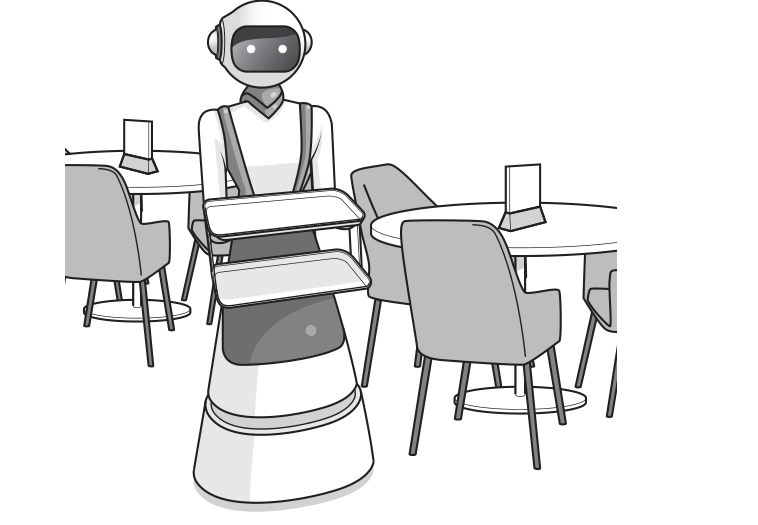
Robots are used to serve food and drink to customers at a restaurant.
(a) A robot navigates through the restaurant to the table it is serving. 2 marks
Complete the table by identifying two sensors that can be included in the robot and the purpose of each sensor in the navigation system.
| Sensor | Purpose of sensor in navigation system |
|---|---|
(b) The robot uses Artificial Intelligence (AI) to communicate with the customers. The customers speak to the robot to order their food and drinks. 3 marks
Explain how AI will be used in this part of the robot.
(c) The navigation system can be considered an example of a control system. 2 marks
Describe how feedback is used in a control system.
(d) The robot includes a touchscreen for the customer to make their payment. 4 marks
Describe the principal operation of a touchscreen.
(e) Program libraries were used when writing the robot’s software.
(i) State what is meant by a program library . 1 mark
(ii) Some program libraries include Dynamic Link Library (DLL) files. 4 marks
Describe the benefits of a programmer using a library with DLL files instead of using a library that does not include DLL files.
(f) The data from the robots is transmitted to a central computer using a wireless connection.
(i) Complete the table by identifying and describing two methods of data verification that can be used during data transfer. 4 marks
| Method | Description | |
|---|---|---|
| 1 | ||
| 2 |
(ii) Explain how encryption can protect the security of data during transmission. 2 marks
Show mark scheme
7(a) [2 marks]
1 mark for sensor and matching purpose to max 2 : Sensor Purpose of sensor in navigation system Pressure To detect if a table or other obstacle has been hit // to detect when food is put on/taken off the tray so it can move on Infra-red To detect if there is an obstacle in the way // to indicate that it has reached the desired table Sound To detect if someone is speaking so that it can use AI to decipher the speech and whether the robot is required to stop
7(b) [2 marks]
1 mark each to max 3 : e.g. Voice/speech recognition is used ... to identify if someone speaking The sound is recorded and analysed The audio recordings are compared to a database of words/sound waves ... to identify the word that has the highest probability of being said Natural language recognition is used Words are combined and compared to known sentences … programmed action(s) for matching sentence(s) are performed
7(c)
1 mark each to max 2 : Feedback ensures that a system operates within set criteria / constraints ... by enabling system output to affect subsequent system input ... thus allowing conditions to be automatically adjusted
7(d) [1 mark]
1 mark each to max 4 : Resistive: The space between the conductive layers is removed/the layers touch and a circuit is completed Capacitive: The electrical charge changes where the user pressed The point of contact is identified ... from the change in electrical field The software/microprocessor calculates the coordinates
7(e)(i)
1 mark for: Pre-written code/functions/routines that can be imported/called in another program
7(e)(ii) [4 marks]
1 mark each to max 4 : Maintenance not needed to be done by the programmer ... because the DLL is separate from program The calling program does not need recompilation by the programmer when a DLL file changes ... because the DLL file can be updated independently of the calling program … updates will apply to all programs that use the DLL file
7(f)(i) [4 marks]
1 mark for each correct method and 1 mark for corresponding description to max 4 : Method Description Parity byte An additional bit is added to make the number of 1s in the byte odd or even to match the parity. If a byte with an odd number of 1 bits is received when even parity is used, there is an error. Parity block Parity is calculated horizontally and vertically. A parity byte is created from the bits produced by the vertical parity check. This is sent with the data. The parity is re-checked when received and the position of an incorrect bit can be determined. Checksum A calculation is made from the data and the result transmitted with the data. The receiver repeats the calculation and compares the result with the value received. If the two are different, there is an error.
7(f)(ii) [2 marks]
1 mark each to max 2 : Encodes/scrambles data ... so if it is intercepted it cannot be understood Algorithm /key is required to decode the data
(a) State what is meant by the following terms in a relational database model. 3 marks
Entity
Primary key
Referential integrity
(b) Authentication is one method a Database Management System (DBMS) can use to improve the security of a database. 4 marks
Describe other methods that a DBMS can use to improve the security of a database.
Show mark scheme
2(a) [3 marks]
1 mark for each term ( max 3 ) Entity: • An object about which data can be stored Primary key: • The unique attribute / combination of attributes used to identify the record / tuple Referential integrity: • Makes sure that if data is changed in one place the change is reflected in all related records - cascading update/delete • Makes sure that data that does not exist cannot be referenced • Ensures that every foreign key has a corresponding primary key // A logical dependency of a foreign key on a primary key • Ensures that the data in the database is consistent / up to date • Prevents records from being added/deleted/modified incorrectly • Makes sure any queries return accurate and complete results
2(b) [4 marks]
1 mark for each bullet point ( max 4 ) Max 2 if no descriptions • Backup / recovery procedures • … automatically takes copies of the database and store off site on a regular basis / weekly, etc. • ... so that the data can be recovered if lost • Use of access rights • … some users are given different access permissions to different tables • ... read/write, read only, full access, etc. • Views • … different users are able to see different parts of the database • ... only see what users need to see // by example • Record and table locking • … prevents simultaneous access to data • ... so updates are not lost // data is not overwritten • Encryption • ... the data is turned into ciphertext • ... so it cannot be understood without a decryption key
2(c) [4 marks]
1 mark for each bullet point ( max 4 ) • Identify repeating groups of attributes ... • ... Subject and SubjectCode • Ensure each field is atomic • ... StudentName should be split into e.g. FirstName and LastName • Identify the primary key for the table
(a) State the meaning of privacy of data . 1 mark
(b) State the meaning of integrity of data . 1 mark
(c) Describe the following threats to a computer system. 4 marks
Phishing email
Spyware
Show mark scheme
5(a) [1 mark]
1 mark for: Either • Ensuring data can only be accessed by / disclosed to authorised persons Or • Ensuring data cannot be accessed by / disclosed to unauthorised persons
5(b) [1 mark]
1 mark for each bullet point ( max 1 ) • Ensuring the accuracy / completeness / consistency of data (during / after processing) • Ensuring the data is up to date
5(c) [4 marks]
1 mark for each bullet point. Phishing email ( max 2 ) • The email pretends to be from an official body • ... persuading individuals to disclose private information // by example such as bank details • ... or requesting authentication by redirecting to an unofficial/unauthorised website // inviting a user to click a link Spyware ( max 2 ) • Malware downloaded without the user’s knowledge • ... which secretly records the user’s actions / keystrokes on the computer • ... and sends logs of the actions to a third party
A company sells online Computer Science courses to students in different countries.
The courses are stored on a public cloud.
(a) (i) Explain why the company uses a public cloud to store these courses. 2 marks
(ii) Describe two disadvantages of storing data on a public cloud compared to storing data on a server in a Local Area Network (LAN). 4 marks
1
2
(iii) State how the following security measures can be used to protect computer systems. 3 marks
Firewall
Encryption
Passwords
Show mark scheme
3(a)(i) [2 marks]
1 mark for each bullet point ( max 2 ). • Courses must be available to anyone who wishes to follow them • Courses must be available on the internet • Company is willing to share infrastructure with other companies (public) • …which is more economic for the company
3(a)(ii) [4 marks]
1 mark for each bullet point ( max 2 for each disadvantage). • There could be a possible loss of control unlike the LAN • …because the data is stored on a remote infrastructure / someone else’s infrastructure • …reliance on external agency to complete tasks, e.g. backups, security • Requires reliable internet connection • …to ensure access to the remote data, more likely with LAN • Increased recurring costs • ...as cloud provider charges must be paid, costs for LAN once only.
3(a)(iii) [3 marks]
1 mark each for firewall, encryption and passwords. Firewall: • Monitors incoming and outgoing traffic and rejects any traffic that does not meet the set rules Encryption: • Ensures that if data is intercepted / obtained it cannot be understood without the decryption key Passwords: • Ensures only users with the correct password can access the resources // prevents unauthorised access
3(b)(i) [1 mark]
1 mark for both 1:M relationships as follows:
3(b)(ii) [4 marks]
1 mark for each bullet point. • SELECT Count(CourseID) • AS NumOfCourses • FROM COURSE_SCHEDULE • WHERE DateStarted > "09/09/23"; SELECT Count(CourseID) AS NumOfCourses FROM COURSE_SCHEDULE WHERE DateStarted > "09/09/23";
3(c) [4 marks]
1 mark for each bullet point. • The administrator completes a visual check / checks by eye • …that the tutor identifier input matches the tutor identifier on the original document • Double entry check // the administrator (or a second person) enters the number a second time • …and the system compares it with the first entry
(a) Data verification is one method of protecting the integrity of data. 2 marks
Describe one other method of protecting the integrity of data.
(b) State one difference and one similarity between pharming and phishing. 2 marks
Difference
Similarity
(c) Explain how the data security risks of malware can be restricted. 3 marks
Show mark scheme
8(a) [2 marks]
1 mark for each bullet point ( max 2 ) • Validation // a validation method named or described • …protects the data by ensuring that the data is reasonable / sensible and within specified bounds
8(b) [2 marks]
1 mark for difference 1 mark for similarity Difference: • Pharming is malicious code that redirects to a fake website . Phishing uses an email to prompt user action. • Pharming is automatic . Phishing requires user action . Similarity: • Both try to obtain financial or personal information • Both are a false representation of an official organisation, e.g. a bank • Both make use of fake websites
8(c) [3 marks]
1 mark for each bullet point ( max 3 ). • Download programs from reputable websites / sources • …as these are less likely to contain malware • Backup / archive computer systems • …so they can be restored in case of data loss from malware program installation • Install and run anti-malware program • …so that regular scans can be made for known malware • …and if malware is found it can be quarantined / removed • …and computer’s anti-malware definitions are regularly updated • Using a firewall to block unused ports • …so that malware cannot enter the computer system • Deny administrator privileges to everyday users • …so that malware cannot be downloaded by everyday users • Avoid the use of / access to removable devices • …so that malware cannot be installed from these devices
Data needs to be kept secure when stored on a computer and during transmission over a network.
(a) Explain how a digital signature is used to authenticate a digital document during transmission over a network. 5 marks
(b) Complete the table by identifying and describing two types of software that can be installed on a computer to prevent threats over a network. 2 marks
| Type of software | Description |
|---|---|
| ……………………….. ……………………….. |
______ |
| ……………………….. ……………………….. |
______ |
Show mark scheme
6(a)
1 mark each to max 5 The sender hashes the document ... to produce a digest The sender encrypts the digest to create the digital signature The message and the signature are sent to the receiver The receiver decrypts the signature to reproduce the digest The receiver uses the same hashing algorithm on the document received to produce a second digest The receiver compares this digest with the one from the digital signature If both of the receiver’s digests are the same the document is authentic
6(b) [2 marks]
1 mark each for identification and appropriate description of 2 pieces of software, max 2 Type of Description software Antivirus scans the computer for viruses and checks against a stored database of viruses, that needs to be updated regularly and then deletes / quarantines them compares downloaded files to a database of known viruses and prevents the download continuing Antispyware scans the computer for spyware and checks against a stored database of viruses, that needs to be updated regularly and then deletes / quarantines them compares downloaded files to a database of known spyware and prevents the download continuing. Firewall monitors incoming and outgoing traffic and compares it to criteria that are set by the user such as through a whitelist/blacklist/identifying allowed / blocked IP addresses compares incoming and outgoing traffic to criteria blocks those that do not match criteria Antimalware scans the computer for viruses and checks against a stored database of viruses, that needs to be updated regularly and then deletes / quarantines them compares downloaded files to a database of known viruses and prevents the download continuing
The following table shows part of the instruction set for a processor. The processor has one general purpose register, the Accumulator (ACC), and an Index Register (IX).
| Instruction | Explanation | |
|---|---|---|
| Opcode | Operand | Operand |
LDM |
#n |
Immediate addressing. Load the number n to ACC |
LDD |
<address> |
Direct addressing. Load the contents of the location at the given address to ACC |
LDX |
<address> |
Indexed addressing. Form the address from + the contents of the index register. Copy the contents of this calculated address to ACC |
LDR |
#n |
Immediate addressing. Load the number n to IX |
STO |
<address> |
Store contents of ACC at the given address |
ADD |
<address> |
Add the contents of the given address to the ACC |
ADD |
#n |
Add the denary number n to the ACC |
INC |
<register> |
Add 1 to the contents of the register (ACC or IX) |
CMP |
#n |
Compare the contents of ACC with number n |
JPE |
<address> |
Following a compare instruction, jump to if the compare was True |
JPN |
<address> |
Following a compare instruction, jump to if the compare was False |
OUT |
Output to the screen the character whose ASCII value is stored in ACC |
|
END |
Return control to the operating system | |
| can be an absolute or a symbolic address # denotes a denary number, e.g. #123 B denotes a binary number, e.g. B01001101 |
can be an absolute or a symbolic address # denotes a denary number, e.g. #123 B denotes a binary number, e.g. B01001101 |
can be an absolute or a symbolic address # denotes a denary number, e.g. #123 B denotes a binary number, e.g. B01001101 |
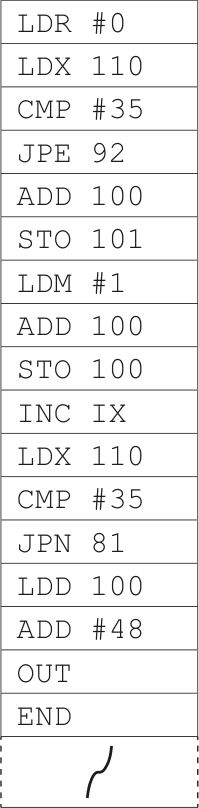
(a) The current contents of main memory and selected values from the ASCII character set are given.
(i) Trace the program currently in memory using the trace table. 4 marks
Address Instruction
…
| Instruction address |
ACC | IX | Memory address | Output | ||||
|---|---|---|---|---|---|---|---|---|
| Instruction address |
ACC | IX | 100 | 101 | 110 | 111 | 112 | 112 |
0 |
0 |
66 |
65 |
35 |
||||
| 101 … 110 111 112 | 0 0 66 65 35 | |||||||
| --- | --- | |||||||
| ASCII value |
Character | |||||||
49 |
1 |
|||||||
50 |
2 |
|||||||
51 |
3 |
|||||||
52 |
4 |
|||||||
65 |
A |
|||||||
66 |
B |
|||||||
67 |
C |
|||||||
68 |
D |
| (ii) The following i | instructions are repeated for your reference. | |
|---|---|---|
| Instruction | Instruction | Explanation |
| Opcode | Operand | Operand |
LDD |
<address> |
Direct addressing. Load the contents of the location at the given address to ACC |
STO |
<address> |
Store contents of ACC at the given address |
State the purpose of this part of an assembly language program.
LDD 100 STO 165 LDD 101 STO 100 LDD 165 STO 101 1 mark
Question 6(b) begins on page 16.
| (b) The following table | e shows another part of the instruction set for the processor. | |
|---|---|---|
| Instruction | Instruction | Explanation |
| Opcode | Operand | Operand |
AND |
#n |
Bitwise AND operation of the contents of ACC with the operand |
AND |
Bn |
Bitwise AND operation of the contents of ACC with the binary number n |
XOR |
#n |
Bitwise XOR operation of the contents of ACC with the operand |
XOR |
Bn |
Bitwise XOR operation of the contents of ACC with the binary number n |
OR |
#n |
Bitwise OR operation of the contents of ACC with the operand |
OR |
Bn |
Bitwise OR operation of the contents of ACC with the binary number n |
LSR |
#n |
Bits in ACC are shifted logically n places to the right. Zeros are introduced on the left-hand end |
| can be an absolute or a symbolic address # denotes a denary number, e.g. #123 B denotes a binary number, e.g. B01001101 |
can be an absolute or a symbolic address # denotes a denary number, e.g. #123 B denotes a binary number, e.g. B01001101 |
can be an absolute or a symbolic address # denotes a denary number, e.g. #123 B denotes a binary number, e.g. B01001101 |
(i) The current contents of the ACC are:
1 0 0 1 0 0 1 1 Show the result after the execution of the following instruction.
XOR B00011111 1 mark
(ii) The current contents of the ACC are:
1 0 0 1 0 0 1 1 Show the result after the execution of the following instruction.
AND B11110000 1 mark
(iii) The current contents of the ACC are:
1 0 0 1 0 0 1 1 Show the result after the execution of the following instruction.
OR B11001100 1 mark
(iv) The current contents of the ACC are:
1 0 0 1 0 0 1 1 Show the result after the execution of the following instruction.
LSR #2 1 mark
(c) Tick (3) one or more boxes in each row to indicate whether the task is performed in the first pass or the second pass of a two-pass assembler. 2 marks
| Task | First pass | Second pass |
|---|---|---|
| Remove comments. | ||
| Read the assembly language program one line at a time. | ||
| Generate the object code. | ||
| Check the opcode is in the instruction set. |
Show mark scheme
6(a)(i) [4 marks]
1 mark for each set of highlighted rows. Memory address Instructio ACC IX Output n address 100 101 110 111 112 0 0 66 65 35 77 0 78 66 79 80 81 82 66 83 1 84 85 1 86 1 87 65 88 89 81 66 82 83 1 84 2 85 2 86 2 87 35 88 89 90 2 91 50 92 2 93
6(a)(ii) [1 mark]
swaps the contents of memory address 100 and 101 1000 1100
6(b)(i) [1 mark]
1001 0000
6(b)(ii) [1 mark]
1101 1111
6(b)(iii) [1 mark]
0010 0100
6(c) [2 marks]
1 mark for each pair of highlighted rows Task First pass Second pass ✓ Remove comments. Read the assembly language program one ✓ ✓ line at a time. ✓ Generate the object code. ✓ Check the opcode is in the instruction set.
(a) State the difference between data verification and data validation . 1 mark
(b) A checksum can be used to detect errors during data transmission. 3 marks
Describe how a checksum is used.
(c) One validation method is a presence check. 2 marks
Describe two other validation methods that can be used to validate non-numeric data.
1
2
Show mark scheme
4(a) [1 mark]
data verification is checking if input data is the same as the original whereas data validation is checking that the data is reasonable / sensible
4(b) [3 marks]
1 mark for each bullet point (max 3) : • checksum value is calculated from the data before transmission // correct description of a checksum algorithm • ... this calculated value is transmitted with the data • receiving computer recalculates the checksum from the received data • if the checksum received and calculated match, no error has occurred // if the checksum received and calculated do not match, an error has occurred
4(c) [2 marks]
1 mark for each bullet point (max 2) . For example: • to make sure data is in the required format // only expected characters allowed • to make sure the data is already present in the system • to make sure the data contains the correct number of characters • to ensure that non-numeric data is entered
(a) A Central Processing Unit (CPU) contains several special purpose registers and other components.
(i) State the roles of the following registers. 2 marks
Memory Address Register (MAR)
Memory Data Register (MDR)
(ii) State when interrupts are detected during the Fetch-Execute (F-E) cycle. 1 mark
(b) A computer system contains a system clock. 2 marks
Describe the purpose of the system clock.
(c) Upgrading secondary storage to solid state typically improves the performance of computer systems. 2 marks
Identify one other upgrade to the hardware and explain why it improves the performance of a computer system.
Upgrade
Explanation
Show mark scheme
4(a)(i) [2 marks]
1 mark for each register: MAR: • holds address in memory from which data will be read / to which data will be written MDR: • holds the data/instructions which has been read from or is to be written to the address in the MAR
4(a)(ii) [1 mark]
after completion of the execute stage // before the cycle begins
4(b) [2 marks]
1 mark for each bullet point ( max 2 ): • synchronise operations • ... by creating timing signals • to keep track of the date and time / timestamp files • to process operations in the correct order / sequence
4(c) [2 marks]
1 mark for identification of a correct upgrade: 1 mark for a corresponding explanation: Examples: • increase quantity of RAM • ... so allowing more applications to reside in memory at the same time, saving disk access times • increase the size of cache memory • ... so that the CPU can continue working without waiting for data • increase clock speed • ... so that more instructions are performed in a time period • increase the number of processors / cores • ... so that more instructions are performed in parallel
A teacher is writing examination papers on a laptop computer. The computer is connected to the internet. The teacher is concerned about the security and privacy of the papers.
(a) State the difference between the security of data and the privacy of data. 1 mark
(b) Identify and describe two threats to the data. Identify one security measure to protect against each threat. Each security measure must be different. 6 marks
Threat 1
Description
Security measure
Threat 2
Description
Security measure
Show mark scheme
3(a) [1 mark]
Security prevents against loss while privacy prevents unauthorised access
3(b) [4 marks]
1 mark for identifying threat, 1 mark for description, 1 mark for security measure ( times 2 ) e.g. Malware Malicious software that replicates and can delete/damage the examination papers Install and run anti-malware Hacker/unauthorised access Illegal access in order to delete/damage the examination papers Use a firewall // strong passwords Spyware Software installed on the computer without the teacher’s knowledge which records keystrokes and sends the data gathered about the examination papers to a third party Use a firewall / install and run anti-spyware / use a virtual (onscreen) keyboard
A school stores personal data about its staff and students on its computer system.
(a) Explain why the school needs to keep both its data and its computer system secure from unauthorised access. 2 marks
Data
Computer system
(b) Complete the table by identifying two security threats to the data on a computer. 6 marks
Describe each threat.
Give a different prevention method for each threat.
| Threat | Description | Prevention method |
|---|---|---|
(c) Data is encrypted when it is transmitted within the school network, or externally such as over the internet. 2 marks
Describe what is meant by encryption and explain why it is used.
Show mark scheme
4(a)
1 mark per point, max 1 for data and max 1 for computer system Data Data needs protecting from someone amending / deleting or taking it Computer System Computer system need protecting to stop people for example, installing malware or damaging the system
4(b) [2 marks]
1 mark for each correct threat, matching description and prevention e.g. Threat Description Prevention method Virus Malicious software that Anti-virus / Firewall / replicates itself and can corrupt Anti-malware data Hacker Unauthorised access to the Firewall / strong or computer with malicious intent biometric passwords / user permissions
4(c)
1 mark per point to max 2 Data is turned into cipher text // Data is encoded Used so that it cannot be understood if intercepted without the decryption key
A company wants to store data about its employees in a computer system. The owner of the company wants to ensure the security and integrity of the data.
(a) (i) State why data needs to be kept secure. 1 mark
(ii) One way the data stored in a computer can be kept secure is by using back-up software. 2 marks
Give two other ways the data stored in a computer can be kept secure.
1
2
(b) The data about the employees is currently stored on paper. The data needs to be transferred into the computer system.
Data validation and verification are used to help maintain the integrity of the data.
(i) Identify and describe one method of data verification that can be used when transferring the data from paper to the computer. 2 marks
Method
Description
(ii) The company needs to transfer the date of birth of each employee into the computer system. 3 marks
Give one example of how each of the following data validation rules can be used to validate the date of birth when it is entered into the system.
Range check
Presence check
Length check
(iii) Explain why the data in the system may not be correct even after validating and verifying the data. 2 marks
Show mark scheme
5(a)(i) [1 mark]
1 mark from To stop the data being lost / corrupted / amended To make sure it can be recovered To prevent unauthorised access
5(a)(ii) [2 marks]
1 mark each e.g. Install / run a firewall Up to date Anti-virus / anti-malware (Username and ) ( strong) password Encryption Access rights
5(b)(i) [2 marks]
1 mark each Visual check Manually compare the data entered with the original (document) Double entry Enter the data twice and the system compares them to see if they are the same
5(b)(ii) [2 marks]
1 mark each e.g. Range check: Make sure it is after and before a specific date // e.g. between 1900 and today's date // check month is between 1 and 12 // check day is between 1 and month end Presence check: Make sure the date of birth has been entered Length check: Make sure there are at least 1 for day, 1 for month, 2/4 for year // must be 8 characters 1 mark per bullet point to max 2 Validation checks data is reasonable/within bounds it does not check that accurate data has been entered Verification checks if the data matches the data given it does not check if the original data is accurate
Xanthe wants to maintain the integrity and security of data stored on her computer.
(a) Explain the difference between data security and data integrity. 2 marks
(b) Xanthe uses both data validation and data verification when entering data on her computer.
(i) Describe how data validation helps to protect the integrity of the data. Give an example in your answer. 2 marks
Description
Example
(ii) Describe how data verification helps to protect the integrity of the data. Give an example in your answer. 2 marks
Description
Example
(c) Two malware threats are spyware and viruses. 3 marks
Give two similarities and one difference between spyware and a virus.
Similarity 1
Similarity 2
Difference
Show mark scheme
2(a) [2 marks]
1 mark per bullet point security is protecting data from loss / corruption • integrity is ensuring the consistency / accuracy of the data •
2(b)(i)
1 mark per bullet point validation checks that data is reasonable / sensible • example e.g. checking data is the right number / type of characters •
2(b)(ii) [3 marks]
1 mark per bullet point verification checks that data is the same as the original • by example e.g. double entry •
2(c) [3 marks]
1 mark per similarity to max 2 Both are pieces of malicious software • Both are downloaded / installed/run without the user's knowledge • Both can pretend to be / are embedded in other legitimate software when • downloaded // both try to avoid the firewall Both run in the background • 1 mark for difference Virus can damage computer data; spyware only records / accesses data • Virus does not send data out of the computer; spyware sends recorded • data to third party Virus replicates itself; spyware does not replicate itself •
When designing computer systems, it is important to consider the security, integrity and privacy of the data.
Draw one line from each measure to indicate whether it keeps data secure or protects the integrity of data.
Measure
Firewall
Double entry
Data Security
Presence check
Data Integrity
Access rights
Password 2 marks
Show mark scheme
1 [2 marks]
1 mark for 3 correct lines only from Data Security 1 mark for 2 correct lines only from Data Integrity Firewall Double entry Data Security Presence check Access rights Data Integrity Password
Xanthe wants to maintain the integrity and security of data stored on her computer.
(a) Explain the difference between data security and data integrity. 2 marks
(b) Xanthe uses both data validation and data verification when entering data on her computer.
(i) Describe how data validation helps to protect the integrity of the data. Give an example in your answer. 2 marks
Description
Example
(ii) Describe how data verification helps to protect the integrity of the data. Give an example in your answer. 2 marks
Description
Example
(c) Two malware threats are spyware and viruses. 3 marks
Give two similarities and one difference between spyware and a virus.
Similarity 1
Similarity 2
Difference
Show mark scheme
2(a) [2 marks]
1 mark per bullet point security is protecting data from loss / corruption • integrity is ensuring the consistency / accuracy of the data •
2(b)(i)
1 mark per bullet point validation checks that data is reasonable / sensible • example e.g. checking data is the right number / type of characters •
2(b)(ii) [3 marks]
1 mark per bullet point verification checks that data is the same as the original • by example e.g. double entry •
2(c) [3 marks]
1 mark per similarity to max 2 Both are pieces of malicious software • Both are downloaded / installed/run without the user's knowledge • Both can pretend to be / are embedded in other legitimate software when • downloaded // both try to avoid the firewall Both run in the background • 1 mark for difference Virus can damage computer data; spyware only records / accesses data • Virus does not send data out of the computer; spyware sends recorded • data to third party Virus replicates itself; spyware does not replicate itself •
A company has several security measures in place to prevent unauthorised access to the data on its computers.
(a) Describe the difference between the security and privacy of data. 2 marks
(b) Each employee has a username and password to allow them to log onto a computer. An employee’s access rights to the data on the computers is set to either read-only, or read and write. 1 mark
Identify one other software-based measure that could be used to restrict the access to the data on the computers.
(c) The company is also concerned about threats posed by networks and the internet. 2 marks
Identify two threats to the data that are posed by networks and the internet.
Threat 1
Threat 2
Show mark scheme
8(a) [2 marks]
1 mark per bullet point Security protects data against loss • Privacy protects data against unauthorised access •
8(b) [1 mark]
1 mark for a correct answer Two factor authentication • Biometric passwords • Key Card Access • Firewall •
8(c) [2 marks]
1 mark per correct answer to max 2 Malware // viruses // spyware // by example • Hacking • Phishing • Pharming •