12.1 Program Development Lifecycle
AS Level · 1 question found
What this topic covers
Section titled “What this topic covers”- Purpose of a development life cycle
- Lifecycle models: waterfall, iterative, rapid application development (RAD)
- Principles, benefits and drawbacks of each model
- Stages: analysis, design, coding, testing, maintenance
Past paper questions
Section titled “Past paper questions” Q8
Permission to reproduce items where third-party owned material protected by copyright is included has been sought and cleared where possible. Every
reasonable effort has been made by the publisher (UCLES) to trace copyright holders, but if any items requiring clearance have unwittingly been included, the
publisher will be pleased to make amends at the earliest possible opportunity.
To avoid the issue of disclosure of answer-related information to candidates, all copyright acknowledgements are reproduced online in the Cambridge
Assessment International Education Copyright Acknowledgements Booklet. This is produced for each series of examinations and is freely available to download
at www.cambridgeinternational.org after the live examination series.
Cambridge Assessment International Education is part of Cambridge Assessment. Cambridge Assessment is the brand name of the University of Cambridge
8
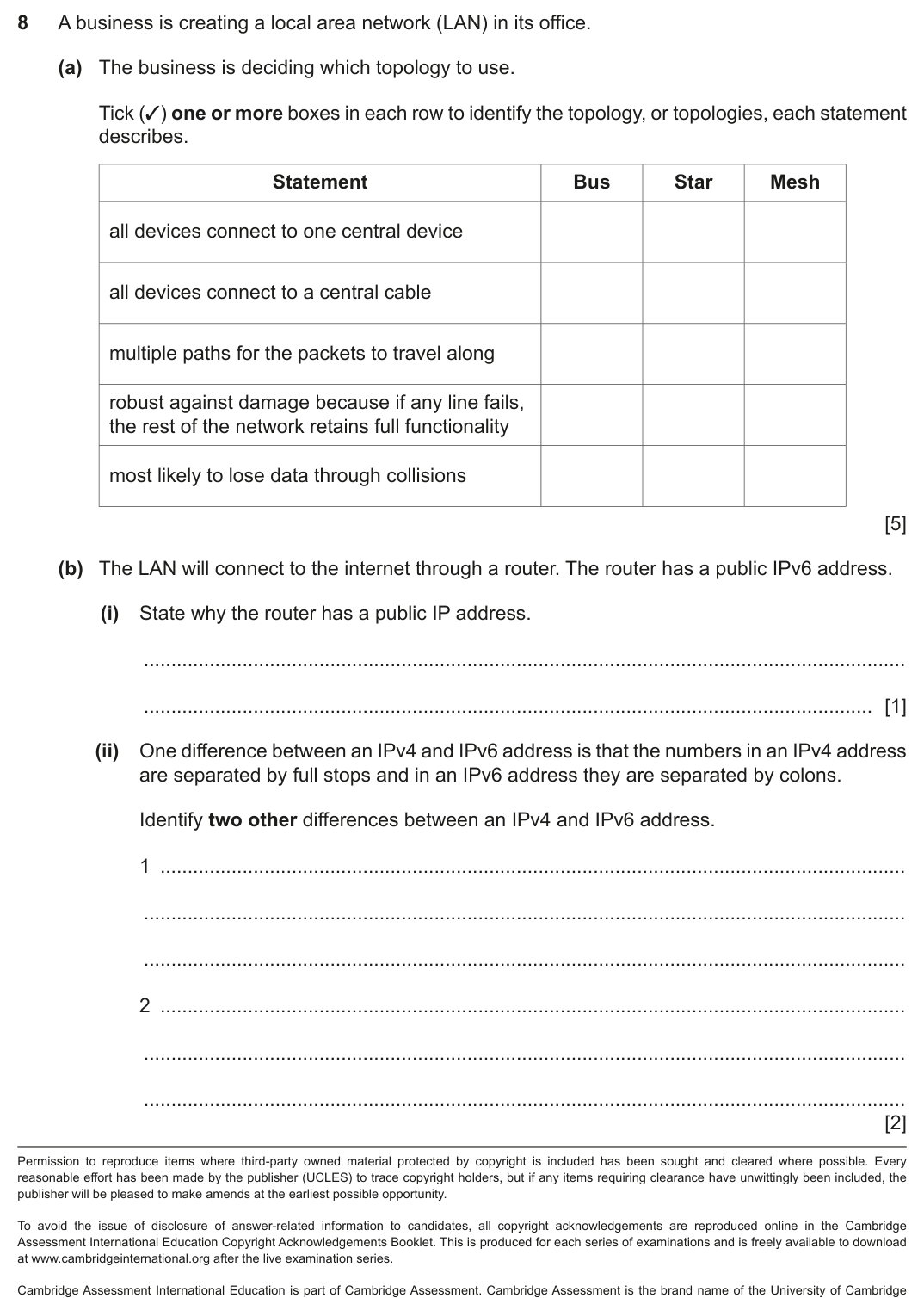
A business is creating a local area network (LAN) in its office.
(a) The business is deciding which topology to use.
Tick (✓) one or more boxes in each row to identify the topology, or topologies, each statement
describes.
Statement
Bus
Star
Mesh
all devices connect to one central device
all devices connect to a central cable
multiple paths for the packets to travel along
robust against damage because if any line fails,
the rest of the network retains full functionality
most likely to lose data through collisions
[5]
(b) The LAN will connect to the internet through a router. The router has a public IPv6 address.
(i) State why the router has a public IP address.
..................................................................................................................................... [1]
(ii) One difference between an IPv4 and IPv6 address is that the numbers in an IPv4 address
are separated by full stops and in an IPv6 address they are separated by colons.
Identify two other differences between an IPv4 and IPv6 address.
1 ........................................................................................................................................
2 ........................................................................................................................................
[2]
Show mark scheme
8(a) [5 marks]
1 mark
for each correct row:
Statement
Bus
Star
Mesh
all devices connect to one central device
all devices connect to a central cable
multiple paths for the packets to travel
robust against damage because if any line fails,
the rest of the network retains full functionality
most likely to lose data through collisions
for each correct row:
Statement
Bus
Star
Mesh
all devices connect to one central device
all devices connect to a central cable
multiple paths for the packets to travel
robust against damage because if any line fails,
the rest of the network retains full functionality
most likely to lose data through collisions
8(b)(i) [1 mark]
1 mark
for:
to
be visible
to and accessible by other devices on the internet
for:
to
be visible
to and accessible by other devices on the internet
8(b)(ii) [2 marks]
1 mark
each:
IPv4 has 4 groups of digits whilst IPv6 has 8 groups
IPv4 is usually represented in
denary
whilst IPv6 is usually represented
in
hexadecimal
IPv4 groups are between 0 and 255 whilst IPv6 is between 0 and FFFF
IPv4 is
32
bits whilst IPv6 is
128 bits
each:
IPv4 has 4 groups of digits whilst IPv6 has 8 groups
IPv4 is usually represented in
denary
whilst IPv6 is usually represented
in
hexadecimal
IPv4 groups are between 0 and 255 whilst IPv6 is between 0 and FFFF
IPv4 is
32
bits whilst IPv6 is
128 bits