13.3 Floating-point Numbers
A Level · 3 questions found
What this topic covers
Section titled “What this topic covers”- Format of binary floating-point numbers using two’s complement
- Effects of changing mantissa vs exponent bit allocation
- Convert binary floating-point to/from denary; normalise floating-point numbers
- Why normalisation is needed
- Rounding errors; underflow and overflow in floating-point
Past paper questions
Section titled “Past paper questions” Q1

1
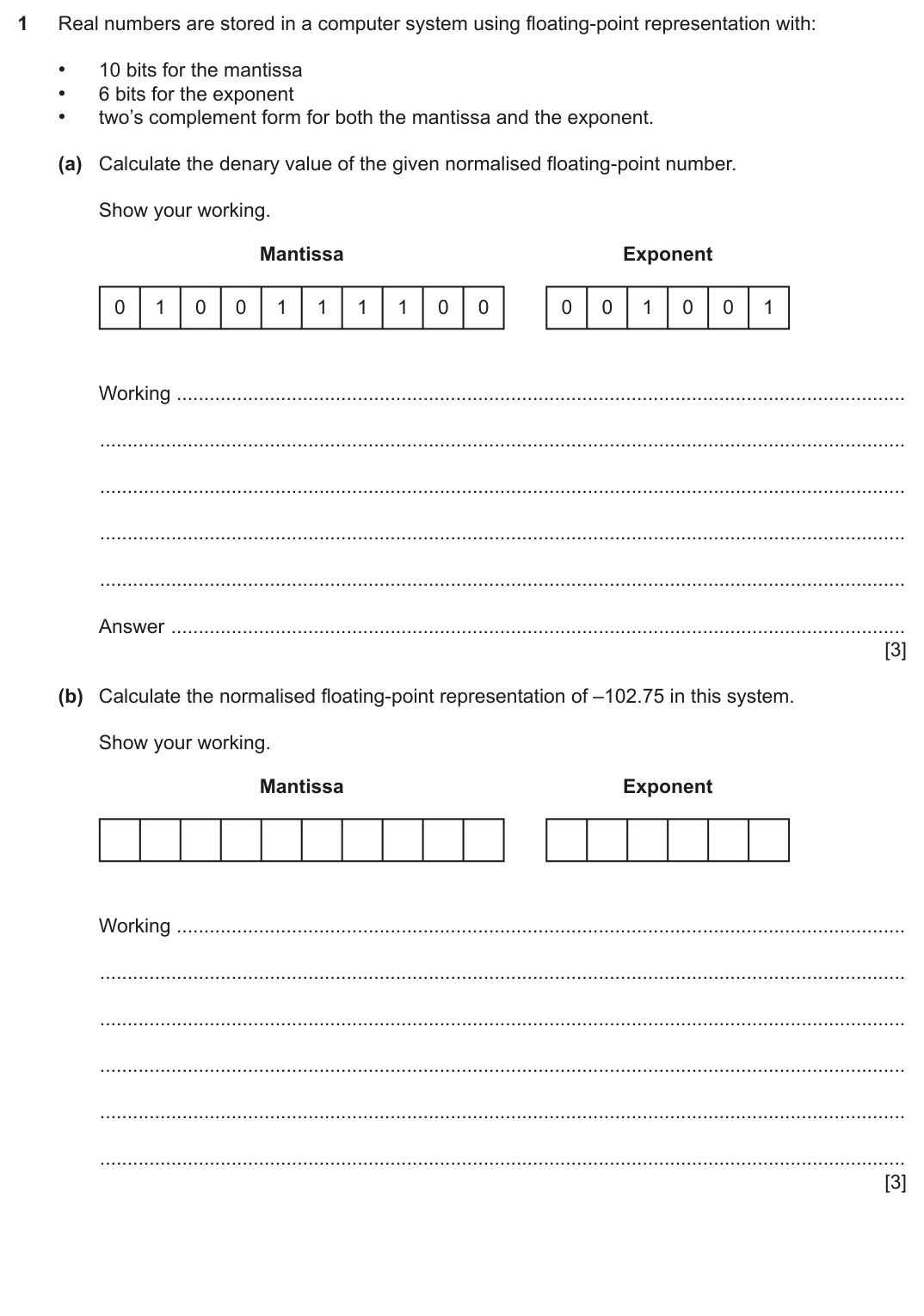
Real numbers are stored in a computer system using floating-point representation with:
•
10 bits for the mantissa
•
6 bits for the exponent
•
two’s complement form for both the mantissa and the exponent.
(a) Calculate the denary value of the given normalised floating-point number.
Show your working.
Mantissa
Exponent
0
0
1
0
0
1
1
1
1
1
0
0
0
1
0
0
Working .....................................................................................................................................
Answer ......................................................................................................................................
[3]
(b) Calculate the normalised floating-point representation of –102.75 in this system.
Show your working.
Mantissa
Exponent
Working .....................................................................................................................................
[3]
Show mark scheme
1(a) [3 marks]
mark per mark point (
Max 3
)
conversion of exponent 001001 to 9
application of exponent to mantissa to go from 0.100111100 to 100111100 // 256 + 32 + 16 + 8 + 4 seen // 64/128
+ 8/128 + 4/128 + 2/128 + 1/128 = 79/128 // 1/2 + 1/16 + 1/32 + 1/64 + 1/128 = 79/128
correct answer = 316
Max 3
)
conversion of exponent 001001 to 9
application of exponent to mantissa to go from 0.100111100 to 100111100 // 256 + 32 + 16 + 8 + 4 seen // 64/128
+ 8/128 + 4/128 + 2/128 + 1/128 = 79/128 // 1/2 + 1/16 + 1/32 + 1/64 + 1/128 = 79/128
correct answer = 316
1(b) [3 marks]
mark per mark point (
Max 3
)
number converted to binary 10011001.01 // number converted to positive 102.75, reversed bits and 1 added.
(0)1100110.11
10011001.00
10011001.01 // -128 + 16 + 8 + 1 + 0.25 = –102.75
exponent = 7 // Moving binary point the correct number of places
correct answer
Mantissa
Exponent
Max 3
)
number converted to binary 10011001.01 // number converted to positive 102.75, reversed bits and 1 added.
(0)1100110.11
10011001.00
10011001.01 // -128 + 16 + 8 + 1 + 0.25 = –102.75
exponent = 7 // Moving binary point the correct number of places
correct answer
Mantissa
Exponent
1
1
1
1
1
1
1
1
Q1

1
(a) Describe the effect of changing the allocation of bits used for the mantissa and for the
exponent in a floating-point number with a fixed total number of bits.
............................................................................................................................................. [2]
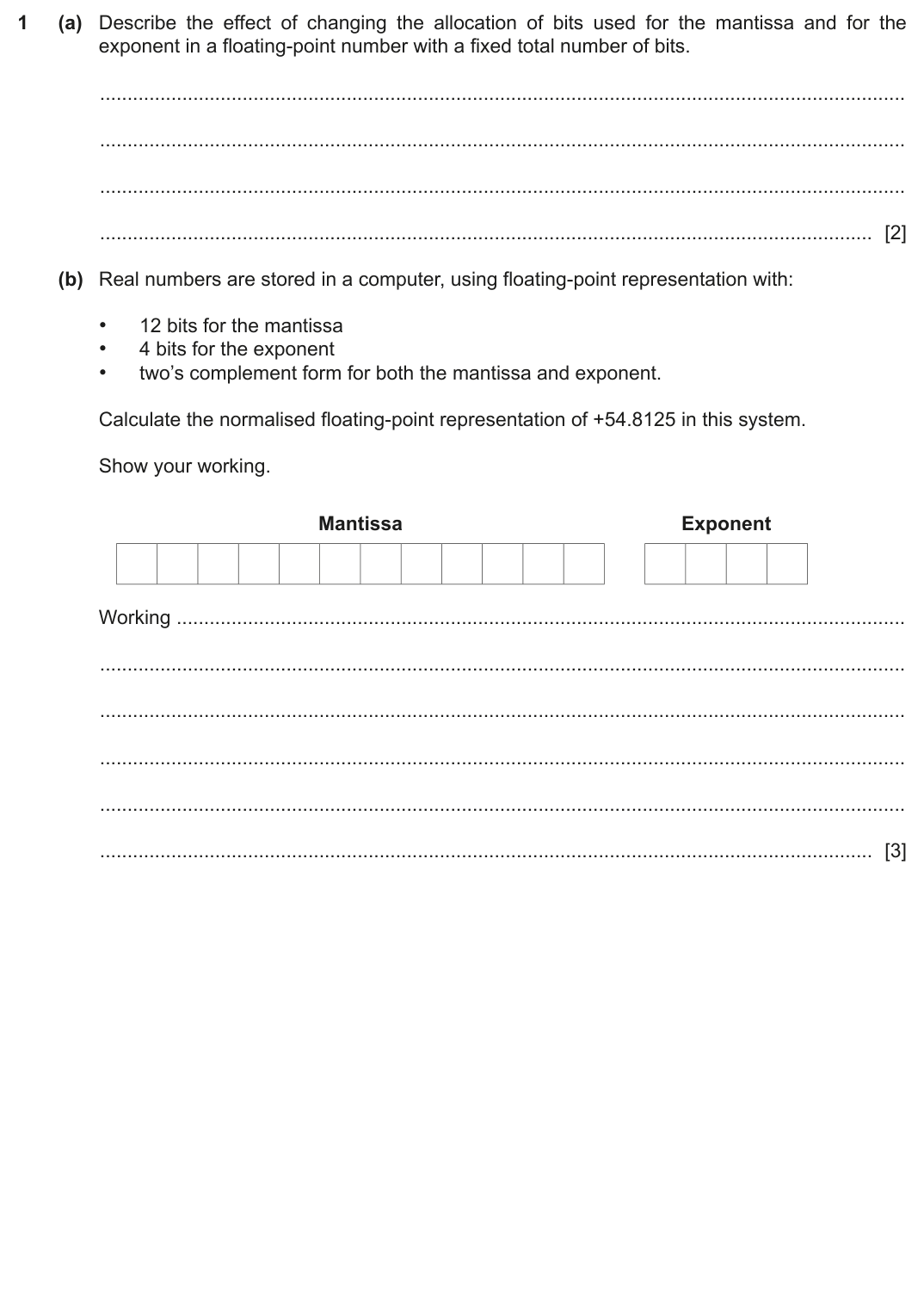
(b) Real numbers are stored in a computer, using floating-point representation with:
•
12 bits for the mantissa
•
4 bits for the exponent
•
two’s complement form for both the mantissa and exponent.
Calculate the normalised floating-point representation of +54.8125 in this system.
Show your working.
Mantissa
Exponent
Working .....................................................................................................................................
............................................................................................................................................. [3]
Show mark scheme
1(a) [2 marks]
mark per mark point (
Max 2
)
When the number of bits in the mantissa is raised, the precision / accuracy of the number represented increases //
when the number of bits in the mantissa is lowered, the precision / accuracy of the number represented reduces.
When the number of bits in the exponent is reduced, the range of numbers that can be represented is reduced //
when the number of bits in the exponent is increased, the range of possible numbers that can be represented
increases.
When the range increases the accuracy decreases // When the range decreases the accuracy increases.
Max 2
)
When the number of bits in the mantissa is raised, the precision / accuracy of the number represented increases //
when the number of bits in the mantissa is lowered, the precision / accuracy of the number represented reduces.
When the number of bits in the exponent is reduced, the range of numbers that can be represented is reduced //
when the number of bits in the exponent is increased, the range of possible numbers that can be represented
increases.
When the range increases the accuracy decreases // When the range decreases the accuracy increases.
1(b) [3 marks]
mark per mark point (
Max 3
)
number converted to binary e.g. 54.8125 = 00110110.1101 // Fractions method 1/2 + 1/4 + 1/16 + 1/32 + 1/128 + 1/256
+ 1/1024 = 877/1024 // 32 + 16 + 4 + 2 + 0.5 + 0.25 + 0.0625 / (1/2 + 1/4 + 1/16)
exponent = 6 // Moving binary point the correct number of places
correct answer
Mantissa
Exponent
Max 3
)
number converted to binary e.g. 54.8125 = 00110110.1101 // Fractions method 1/2 + 1/4 + 1/16 + 1/32 + 1/128 + 1/256
+ 1/1024 = 877/1024 // 32 + 16 + 4 + 2 + 0.5 + 0.25 + 0.0625 / (1/2 + 1/4 + 1/16)
exponent = 6 // Moving binary point the correct number of places
correct answer
Mantissa
Exponent
1
1
1
0
0
0
1
0
1
1
0
0
0
1
0
1
Q1

1
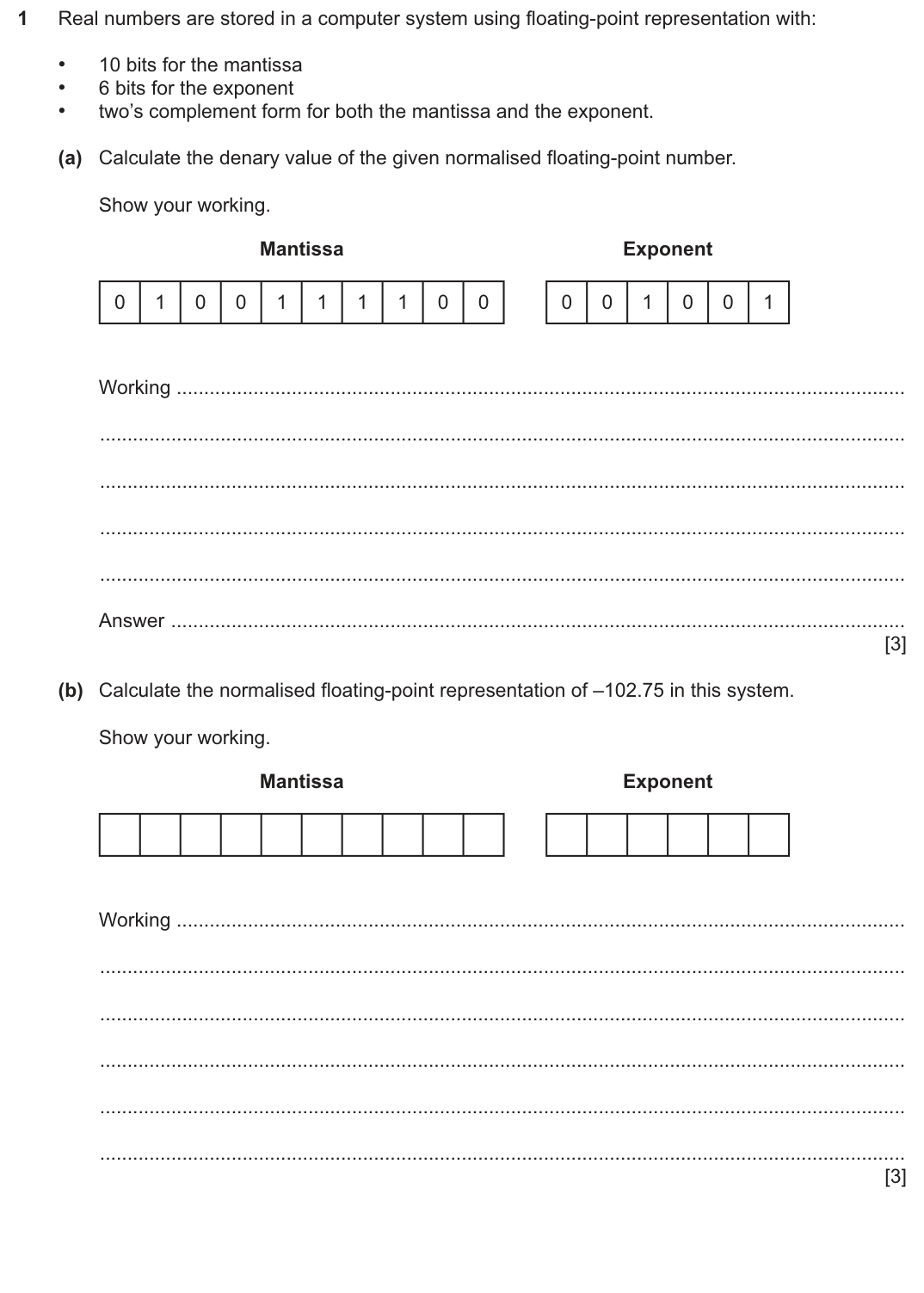
Real numbers are stored in a computer system using floating-point representation with:
•
10 bits for the mantissa
•
6 bits for the exponent
•
two’s complement form for both the mantissa and the exponent.
(a) Calculate the denary value of the given normalised floating-point number.
Show your working.
Mantissa
Exponent
0
0
1
0
0
1
1
1
1
1
0
0
0
1
0
0
Working .....................................................................................................................................
Answer ......................................................................................................................................
[3]
(b) Calculate the normalised floating-point representation of –102.75 in this system.
Show your working.
Mantissa
Exponent
Working .....................................................................................................................................
[3]
,
,
Show mark scheme
1(a) [3 marks]
mark per mark point (
Max 3
)
conversion of exponent 001001 to 9
application of exponent to mantissa to go from 0.100111100 to 100111100 // 256 + 32 + 16 + 8 + 4 seen // 64/128
+ 8/128 + 4/128 + 2/128 + 1/128 = 79/128 // 1/2 + 1/16 + 1/32 + 1/64 + 1/128 = 79/128
correct answer = 316
Max 3
)
conversion of exponent 001001 to 9
application of exponent to mantissa to go from 0.100111100 to 100111100 // 256 + 32 + 16 + 8 + 4 seen // 64/128
+ 8/128 + 4/128 + 2/128 + 1/128 = 79/128 // 1/2 + 1/16 + 1/32 + 1/64 + 1/128 = 79/128
correct answer = 316
1(b) [3 marks]
mark per mark point (
Max 3
)
number converted to binary 10011001.01 // number converted to positive 102.75, reversed bits and 1 added.
(0)1100110.11
10011001.00
10011001.01 // -128 + 16 + 8 + 1 + 0.25 = –102.75
exponent = 7 // Moving binary point the correct number of places
correct answer
Mantissa
Exponent
Max 3
)
number converted to binary 10011001.01 // number converted to positive 102.75, reversed bits and 1 added.
(0)1100110.11
10011001.00
10011001.01 // -128 + 16 + 8 + 1 + 0.25 = –102.75
exponent = 7 // Moving binary point the correct number of places
correct answer
Mantissa
Exponent
1
1
1
1
1
1
1
1