14.1 Protocol Technologies
A Level · 3 questions found
What this topic covers
Section titled “What this topic covers”- Why protocols are essential for communication between computers
- Protocol stack model: each layer has distinct functionality
- TCP/IP four layers: Application, Transport, Internet, Link — purpose and function of each
- How a message travels from one internet host to another
- Protocols and their purposes: HTTP, FTP, POP3, IMAP, SMTP, BitTorrent (P2P file sharing)
Past paper questions
Section titled “Past paper questions” Q2
2
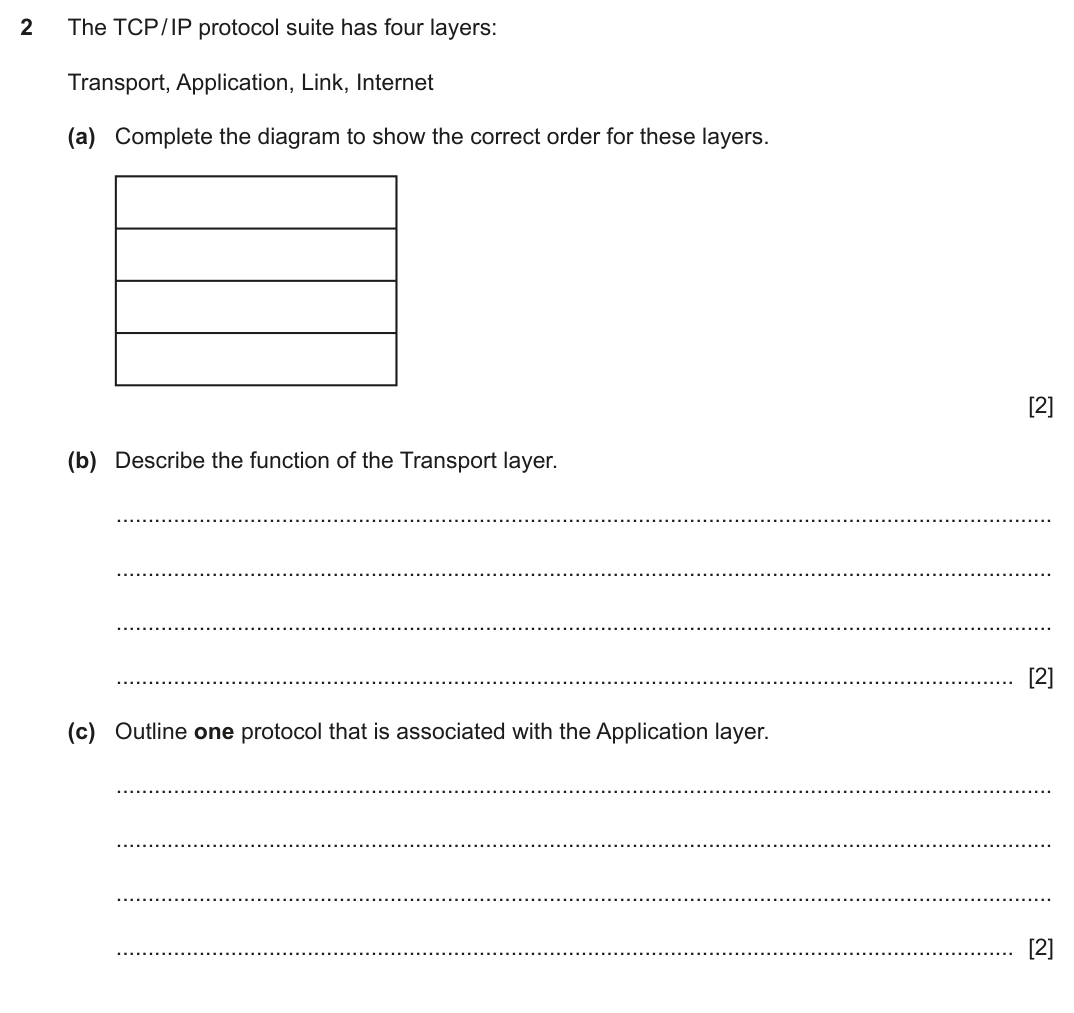
The TCP / IP protocol suite has four layers:
Transport, Application, Link, Internet
(a) Complete the diagram to show the correct order for these layers.
[2]
(b) Describe the function of the Transport layer.
............................................................................................................................................. [2]
(c) Outline one protocol that is associated with the Application layer.
............................................................................................................................................. [2]
Show mark scheme
2(a) [2 marks]
marks for all protocols in correct position
mark for at least two protocols in correct position
Application
Transport
Internet
Link
mark for at least two protocols in correct position
Application
Transport
Internet
Link
2(b) [2 marks]
mark per mark point (
Max 2
)
The transport layer is responsible for delivery of data from the source host to the destination host
It is where data is broken up into packets
and
sent to the internet layer
Adds the sequence number to the packet header
It establishes end to end contact
It ensures data arrives error free // It retransmits packets if lost.
Max 2
)
The transport layer is responsible for delivery of data from the source host to the destination host
It is where data is broken up into packets
and
sent to the internet layer
Adds the sequence number to the packet header
It establishes end to end contact
It ensures data arrives error free // It retransmits packets if lost.
2(c) [2 marks]
mark for name of protocol and one mark for expansion (
Max 2
)
HTTP(S) – responsible for correct transfer of files / hypertext documents that make up web pages on the world wide web
FTP – used when transferring files from a server to a client on a network
POP3 – handles the receiving of emails
IMAP – handles the receiving of emails
SMTP – handles the sending of emails
BitTorrent – provides peer-to-peer file sharing
Max 2
)
HTTP(S) – responsible for correct transfer of files / hypertext documents that make up web pages on the world wide web
FTP – used when transferring files from a server to a client on a network
POP3 – handles the receiving of emails
IMAP – handles the receiving of emails
SMTP – handles the sending of emails
BitTorrent – provides peer-to-peer file sharing
Q2

2
(a) Outline why protocols are essential for communication between computers.
............................................................................................................................................. [2]
(b) State the names of two different protocols associated with the sending and receiving of
emails between computers.
Sending ....................................................................................................................................
Receiving ..................................................................................................................................
[2]
(c) Explain the meaning of the phrase:
BitTorrent protocol provides peer-to-peer file sharing.
............................................................................................................................................. [3]
Show mark scheme
2(a) [2 marks]
mark per mark point (
Max 2
)
Protocols provide a standard set of rules that enables
successful
data transfer between devices.
Allows communication between devices on different platforms.
Makes communications independent of software and hardware.
Max 2
)
Protocols provide a standard set of rules that enables
successful
data transfer between devices.
Allows communication between devices on different platforms.
Makes communications independent of software and hardware.
2(b) [2 marks]
mark per mark point
Sending - SMTP
Receiving – POP3 // IMAP // Post Office Protocol 3
Sending - SMTP
Receiving – POP3 // IMAP // Post Office Protocol 3
2(c) [3 marks]
mark per mark point (
Max 3
)
BitTorrent allows the sharing of files between thousands of users who are connected together over the
internet
.
It allows
more
users to share files with each other than would be the case with a peer-to-peer network.
Users share files
directly
with each other // the users’ computers are acting as peers
… no web server / central device is used // all users are of equal status.
Max 3
)
BitTorrent allows the sharing of files between thousands of users who are connected together over the
internet
.
It allows
more
users to share files with each other than would be the case with a peer-to-peer network.
Users share files
directly
with each other // the users’ computers are acting as peers
… no web server / central device is used // all users are of equal status.
Q2
2
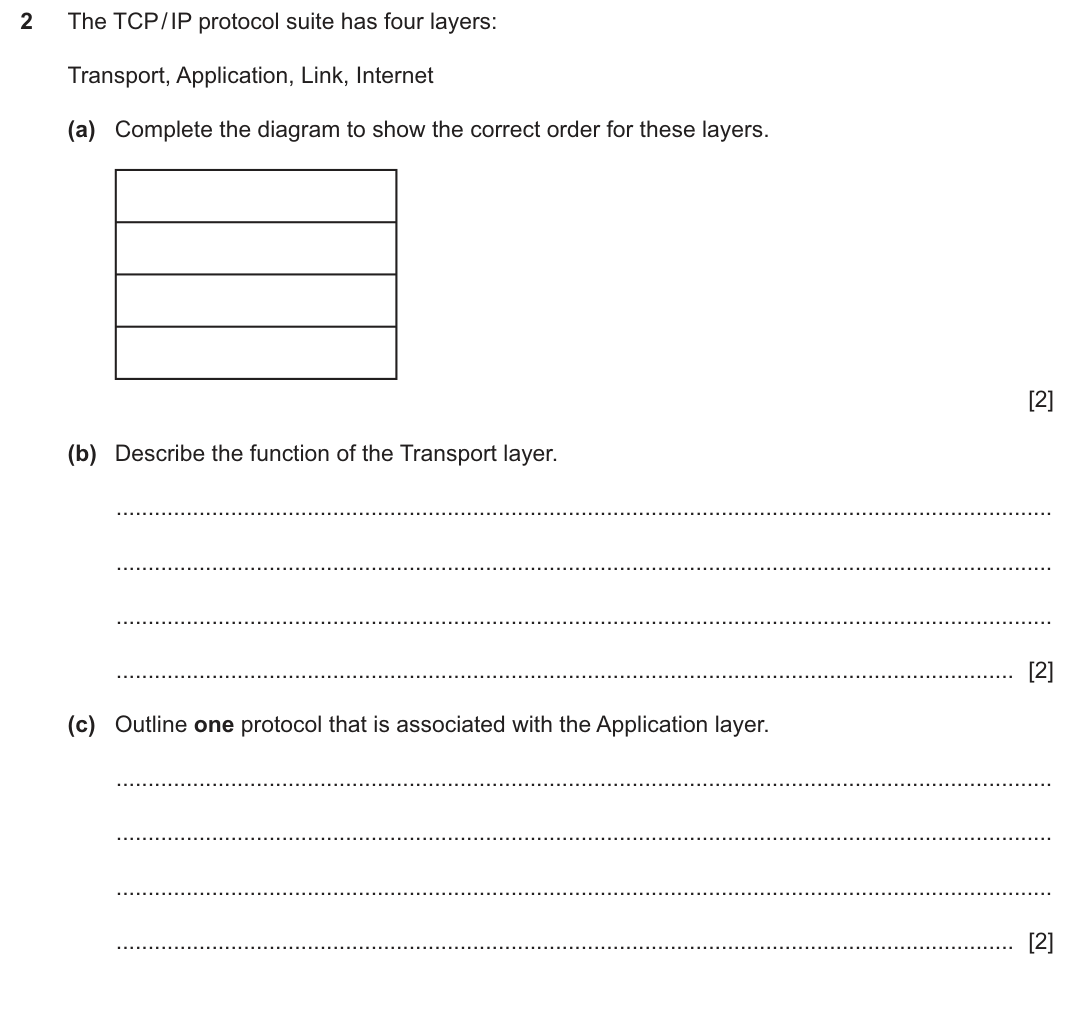
The TCP / IP protocol suite has four layers:
Transport, Application, Link, Internet
(a) Complete the diagram to show the correct order for these layers.
[2]
(b) Describe the function of the Transport layer.
............................................................................................................................................. [2]
(c) Outline one protocol that is associated with the Application layer.
............................................................................................................................................. [2]
Show mark scheme
2(a) [2 marks]
marks for all protocols in correct position
mark for at least two protocols in correct position
Application
Transport
Internet
Link
mark for at least two protocols in correct position
Application
Transport
Internet
Link
2(b) [2 marks]
mark per mark point (
Max 2
)
The transport layer is responsible for delivery of data from the source host to the destination host
It is where data is broken up into packets
and
sent to the internet layer
Adds the sequence number to the packet header
It establishes end to end contact
It ensures data arrives error free // It retransmits packets if lost.
Max 2
)
The transport layer is responsible for delivery of data from the source host to the destination host
It is where data is broken up into packets
and
sent to the internet layer
Adds the sequence number to the packet header
It establishes end to end contact
It ensures data arrives error free // It retransmits packets if lost.
2(c) [2 marks]
mark for name of protocol and one mark for expansion (
Max 2
)
HTTP(S) – responsible for correct transfer of files / hypertext documents that make up web pages on the world wide web
FTP – used when transferring files from a server to a client on a network
POP3 – handles the receiving of emails
IMAP – handles the receiving of emails
SMTP – handles the sending of emails
BitTorrent – provides peer-to-peer file sharing
Max 2
)
HTTP(S) – responsible for correct transfer of files / hypertext documents that make up web pages on the world wide web
FTP – used when transferring files from a server to a client on a network
POP3 – handles the receiving of emails
IMAP – handles the receiving of emails
SMTP – handles the sending of emails
BitTorrent – provides peer-to-peer file sharing