18.1 Artificial Intelligence
A Level · 3 questions found
What this topic covers
Section titled “What this topic covers”- Graphs in AI: structure and purpose; use A* and Dijkstra’s for AI searches
- Artificial neural networks and machine learning
- Deep Learning, Machine Learning and Reinforcement Learning — why each is used
- ML categories: supervised learning vs unsupervised learning
- Back propagation of errors; regression methods in machine learning
Past paper questions
Section titled “Past paper questions” Q9
9
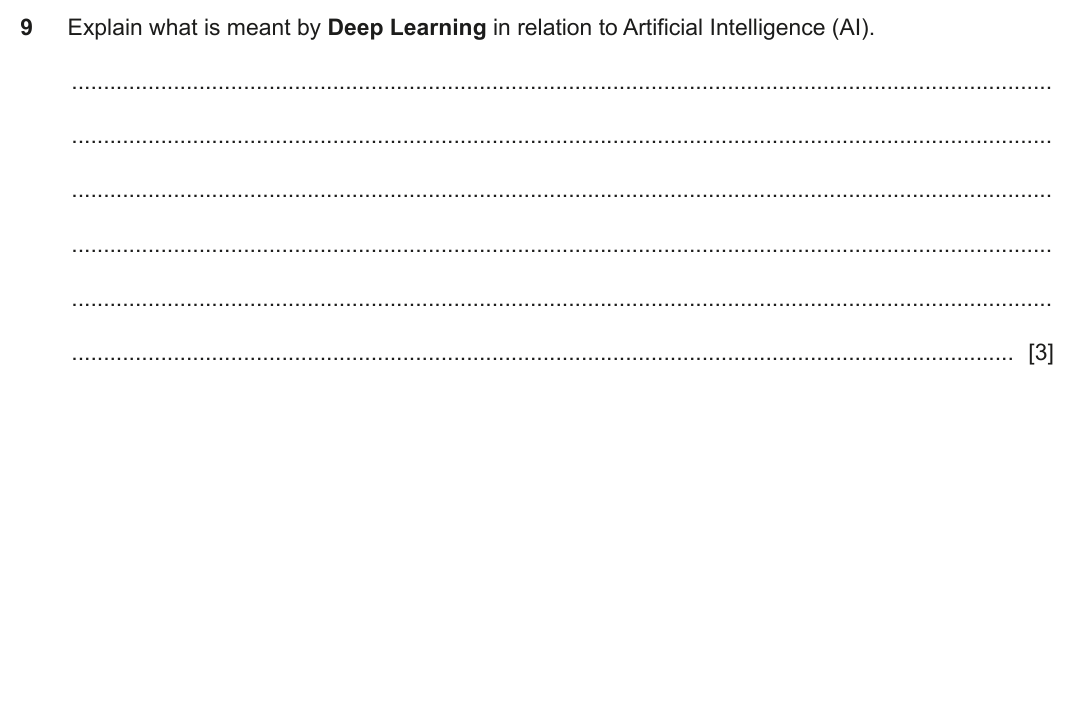
Explain what is meant by Deep Learning in relation to Artificial Intelligence (AI).
.................................................................................................................................................... [3]
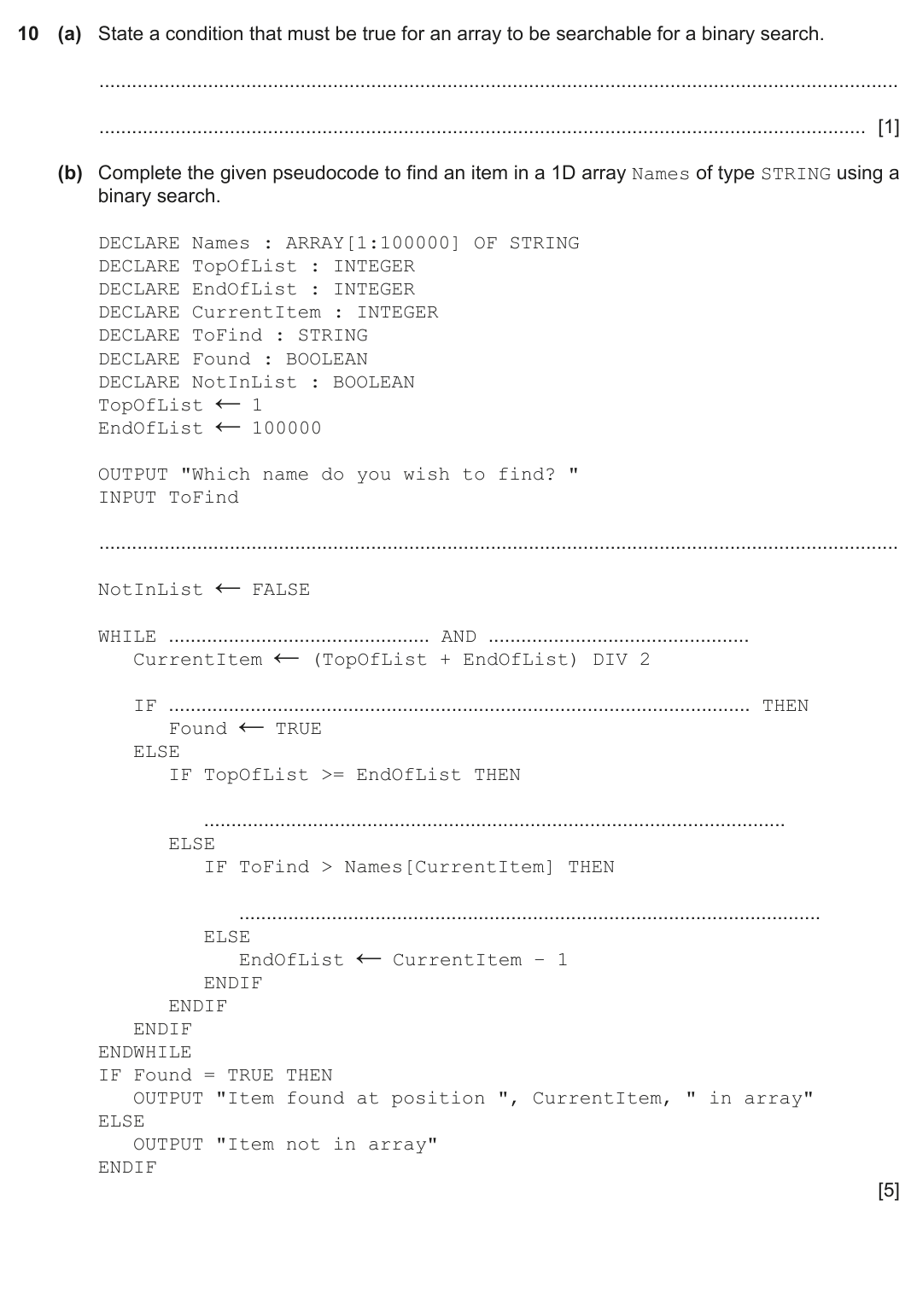
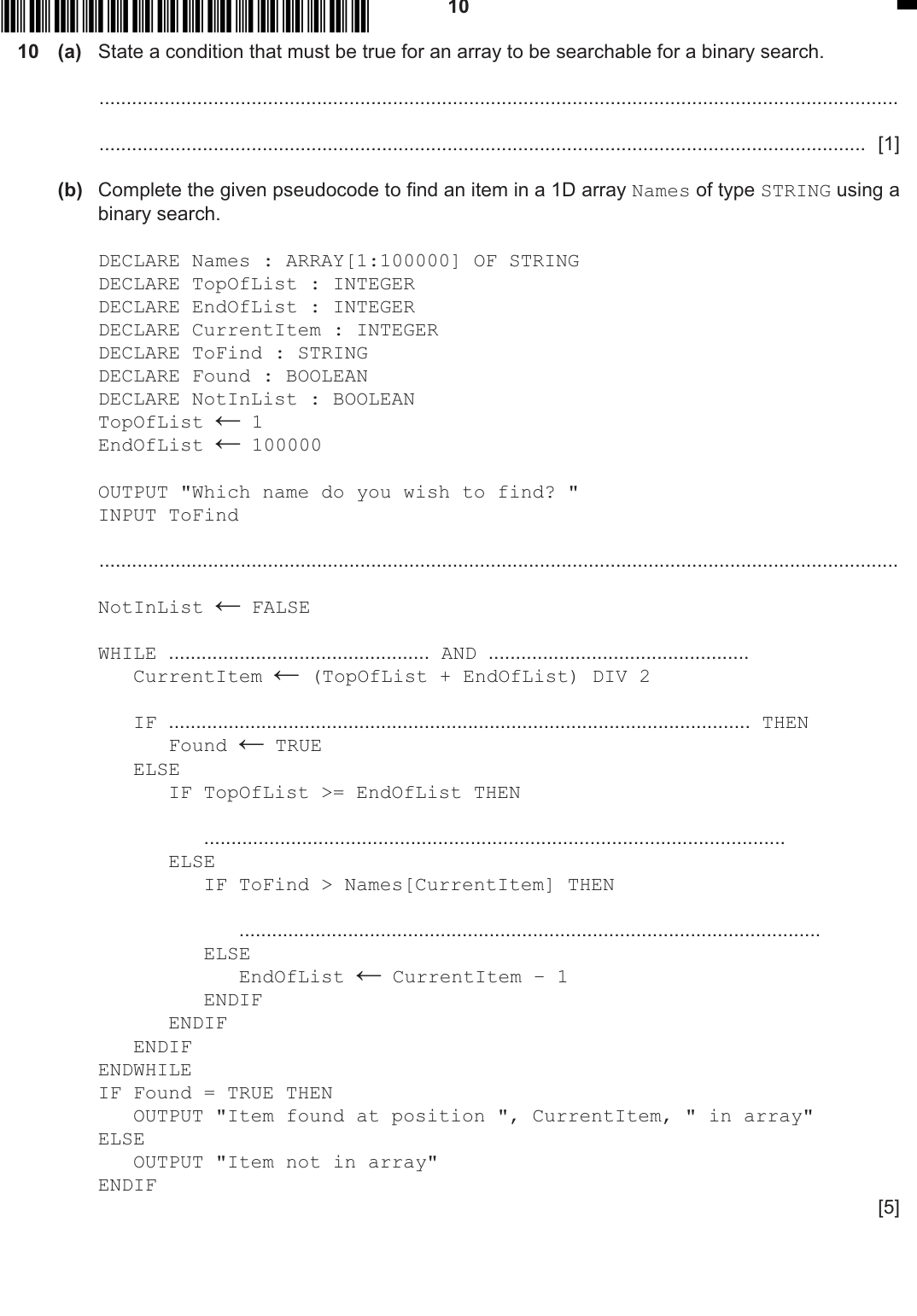
10 (a) State a condition that must be true for an array to be searchable for a binary search.
............................................................................................................................................. [1]
(b) Complete the given pseudocode to find an item in a 1D array Names of type STRING using a
binary search.
DECLARE Names : ARRAY[1:100000] OF STRING
DECLARE TopOfList : INTEGER
DECLARE EndOfList : INTEGER
DECLARE CurrentItem : INTEGER
DECLARE ToFind : STRING
DECLARE Found : BOOLEAN
DECLARE NotInList : BOOLEAN
TopOfList ← 1
EndOfList ← 100000
OUTPUT "Which name do you wish to find? "
INPUT ToFind
NotInList ← FALSE
WHILE ................................................ AND ................................................
CurrentItem ← (TopOfList + EndOfList) DIV 2
IF ........................................................................................................... THEN
Found ← TRUE
ELSE
IF TopOfList >= EndOfList THEN
ELSE
IF ToFind > Names[CurrentItem] THEN
ELSE
EndOfList ← CurrentItem – 1
ENDIF
ENDIF
ENDIF
ENDWHILE
IF Found = TRUE THEN
OUTPUT "Item found at position ", CurrentItem, " in array"
ELSE
OUTPUT "Item not in array"
ENDIF
[5]
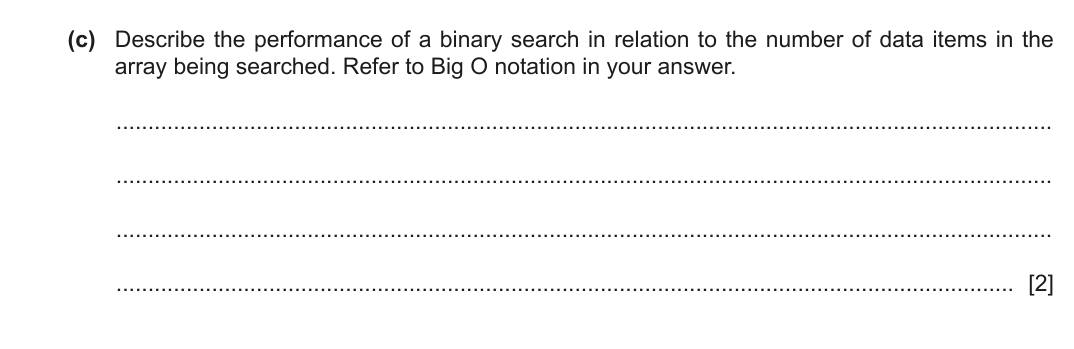
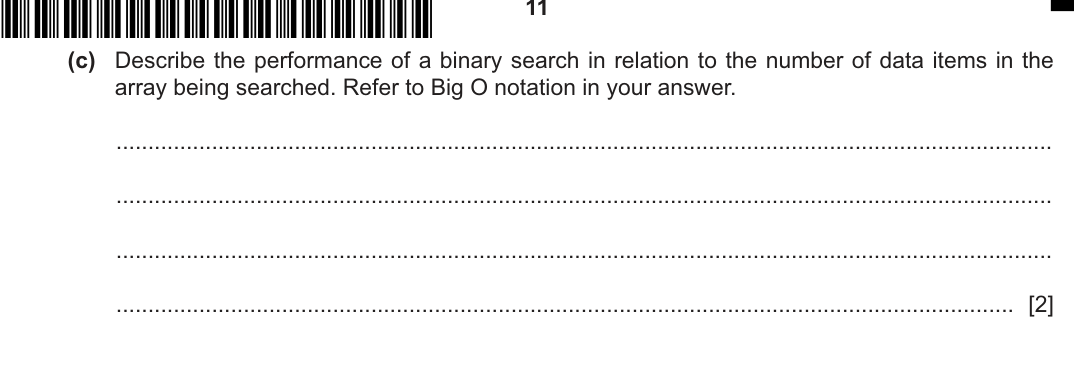
(c) Describe the performance of a binary search in relation to the number of data items in the
array being searched. Refer to Big O notation in your answer.
............................................................................................................................................. [2]
Show mark scheme
9 [3 marks]
mark per mark point (
Max 3
)
Deep learning learns by finding hidden patterns that are
undetectable to humans
.
It structures algorithms in layers:
input
layer,
hidden
layers and
output
layer.
… to create an artificial neural network to learn and make intelligent decisions on its own.
It is trained using large quantities of unlabelled data.
Deep learning requires/uses
a large number of
hidden layers.
… the larger the number of layers, the higher the level of success.
Max 3
)
Deep learning learns by finding hidden patterns that are
undetectable to humans
.
It structures algorithms in layers:
input
layer,
hidden
layers and
output
layer.
… to create an artificial neural network to learn and make intelligent decisions on its own.
It is trained using large quantities of unlabelled data.
Deep learning requires/uses
a large number of
hidden layers.
… the larger the number of layers, the higher the level of success.
Q11

Permission to reproduce items where third-party owned material protected by copyright is included has been sought and cleared where possible. Every
reasonable effort has been made by the publisher (UCLES) to trace copyright holders, but if any items requiring clearance have unwittingly been included, the
publisher will be pleased to make amends at the earliest possible opportunity.
To avoid the issue of disclosure of answer-related information to candidates, all copyright acknowledgements are reproduced online in the Cambridge
Assessment International Education Copyright Acknowledgements Booklet. This is produced for each series of examinations and is freely available to download
at www.cambridgeinternational.org after the live examination series.
Cambridge Assessment International Education is part of Cambridge Assessment. Cambridge Assessment is the brand name of the University of Cambridge
11 Explain what is meant by Reinforcement Learning in relation to Artificial Intelligence.
.................................................................................................................................................... [3]
Show mark scheme
11 [3 marks]
mark per mark point
(
Max 3
)
Reinforcement learning is a machine learning technique based on feedback / rewards / punishment.
… in which an agent learns to behave in an environment by performing the actions and seeing the results of the
actions.
… for each good action, the agent gets positive feedback / reward and each bad action receives negative feedback
/ punishment.
The agent learns automatically using feedback without any labelled data / specific instructions.
Adjust node weightings to achieve the correct outcome. // Using feedback to improve its performance at
accomplishing similar tasks.
(
Max 3
)
Reinforcement learning is a machine learning technique based on feedback / rewards / punishment.
… in which an agent learns to behave in an environment by performing the actions and seeing the results of the
actions.
… for each good action, the agent gets positive feedback / reward and each bad action receives negative feedback
/ punishment.
The agent learns automatically using feedback without any labelled data / specific instructions.
Adjust node weightings to achieve the correct outcome. // Using feedback to improve its performance at
accomplishing similar tasks.
Q9
9
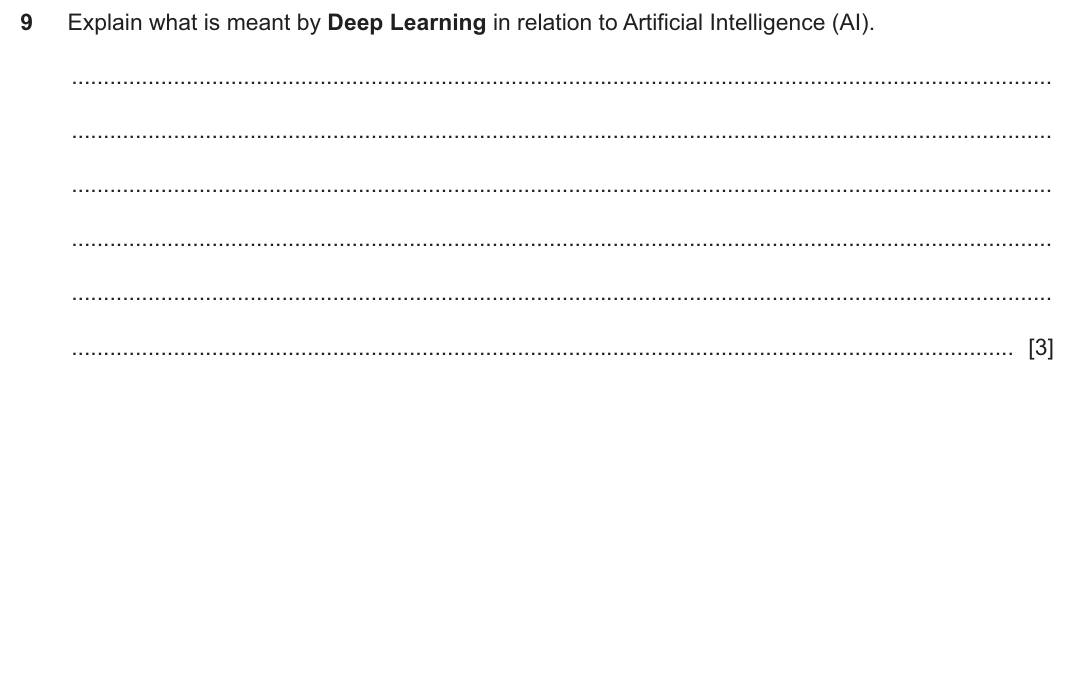
Explain what is meant by Deep Learning in relation to Artificial Intelligence (AI).
.................................................................................................................................................... [3]
10 (a) State a condition that must be true for an array to be searchable for a binary search.
............................................................................................................................................. [1]
(b) Complete the given pseudocode to find an item in a 1D array Names of type STRING using a
binary search.
DECLARE Names : ARRAY[1:100000] OF STRING
DECLARE TopOfList : INTEGER
DECLARE EndOfList : INTEGER
DECLARE CurrentItem : INTEGER
DECLARE ToFind : STRING
DECLARE Found : BOOLEAN
DECLARE NotInList : BOOLEAN
TopOfList ← 1
EndOfList ← 100000
OUTPUT "Which name do you wish to find? "
INPUT ToFind
NotInList ← FALSE
WHILE ................................................ AND ................................................
CurrentItem ← (TopOfList + EndOfList) DIV 2
IF ........................................................................................................... THEN
Found ← TRUE
ELSE
IF TopOfList >= EndOfList THEN
ELSE
IF ToFind > Names[CurrentItem] THEN
ELSE
EndOfList ← CurrentItem – 1
ENDIF
ENDIF
ENDIF
ENDWHILE
IF Found = TRUE THEN
OUTPUT "Item found at position ", CurrentItem, " in array"
ELSE
OUTPUT "Item not in array"
ENDIF
[5]
,
,
(c) Describe the performance of a binary search in relation to the number of data items in the
array being searched. Refer to Big O notation in your answer.
............................................................................................................................................. [2]
,
,
Show mark scheme
9 [3 marks]
mark per mark point (
Max 3
)
Deep learning learns by finding hidden patterns that are
undetectable to humans
.
It structures algorithms in layers:
input
layer,
hidden
layers and
output
layer.
… to create an artificial neural network to learn and make intelligent decisions on its own.
It is trained using large quantities of unlabelled data.
Deep learning requires/uses
a large number of
hidden layers.
… the larger the number of layers, the higher the level of success.
Max 3
)
Deep learning learns by finding hidden patterns that are
undetectable to humans
.
It structures algorithms in layers:
input
layer,
hidden
layers and
output
layer.
… to create an artificial neural network to learn and make intelligent decisions on its own.
It is trained using large quantities of unlabelled data.
Deep learning requires/uses
a large number of
hidden layers.
… the larger the number of layers, the higher the level of success.