4.2 Assembly Language
AS Level · 3 questions found
What this topic covers
Section titled “What this topic covers”- Relationship between assembly language and machine code
- Two-pass assembler: stages and applying to a program
- Trace a simple assembly language program
- Instruction groups: data movement, I/O, arithmetic, jump, compare
- Addressing modes: immediate, direct, indirect, indexed, relative
- Key instructions: LDM, LDD, LDI, LDX, STO, ADD, SUB, JMP, CMP, JPE, JPN, IN, OUT, END
Past paper questions
Section titled “Past paper questions” Q4

4
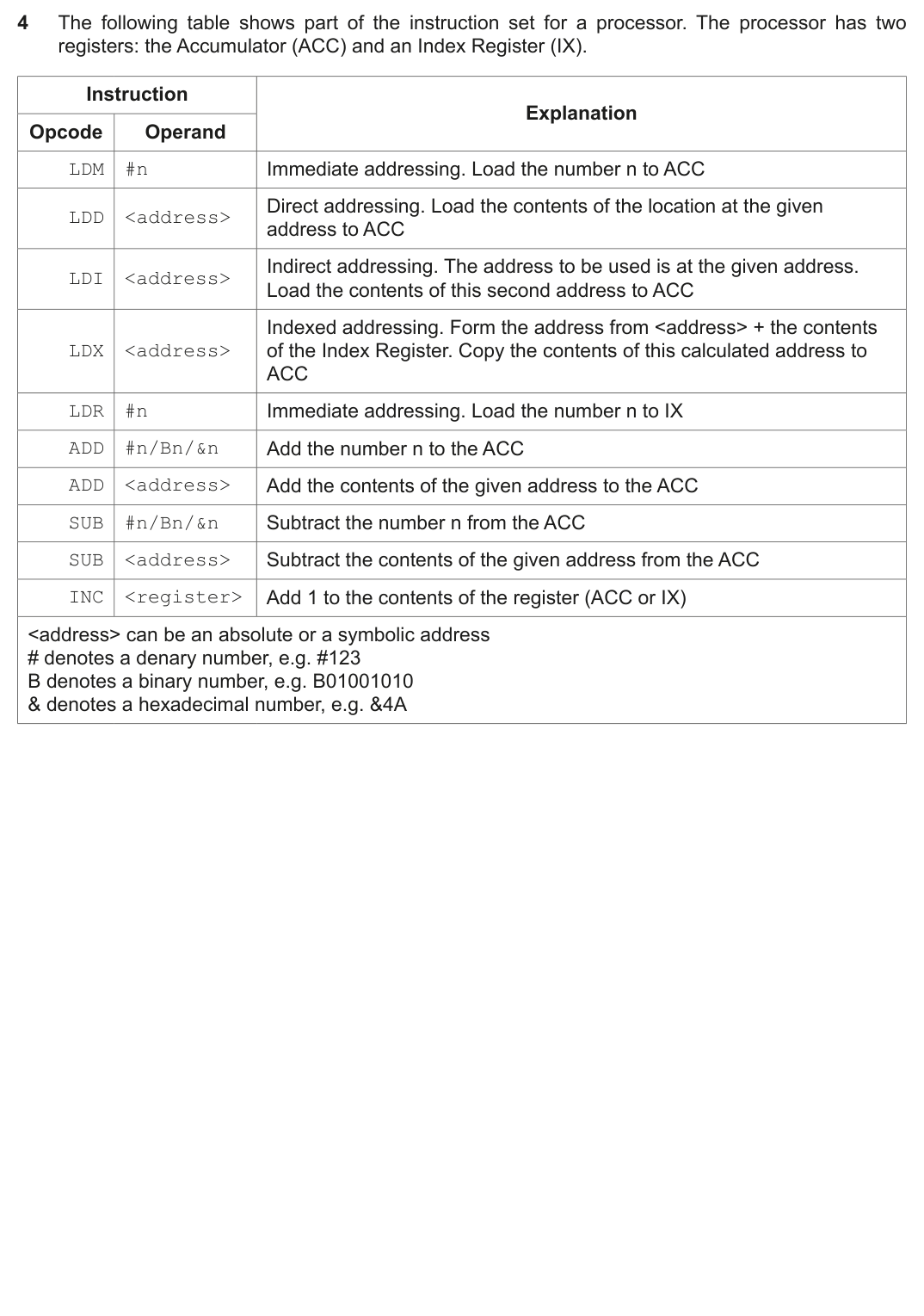
The following table shows part of the instruction set for a processor. The processor has two
registers: the Accumulator (ACC) and an Index Register (IX).
Instruction
Explanation
Opcode
Operand
LDM
#n
Immediate addressing. Load the number n to ACC
LDD
<address>
Direct addressing. Load the contents of the location at the given
address to ACC
LDI
<address>
Indirect addressing. The address to be used is at the given address.
Load the contents of this second address to ACC
LDX
<address>
Indexed addressing. Form the address from <address> + the contents
of the Index Register. Copy the contents of this calculated address to
ACC
LDR
#n
Immediate addressing. Load the number n to IX
ADD
#n/Bn/&n
Add the number n to the ACC
ADD
<address>
Add the contents of the given address to the ACC
SUB
#n/Bn/&n
Subtract the number n from the ACC
SUB
<address>
Subtract the contents of the given address from the ACC
INC
<register>
Add 1 to the contents of the register (ACC or IX)
<address> can be an absolute or a symbolic address
# denotes a denary number, e.g. #123
B denotes a binary number, e.g. B01001010
& denotes a hexadecimal number, e.g. &4A
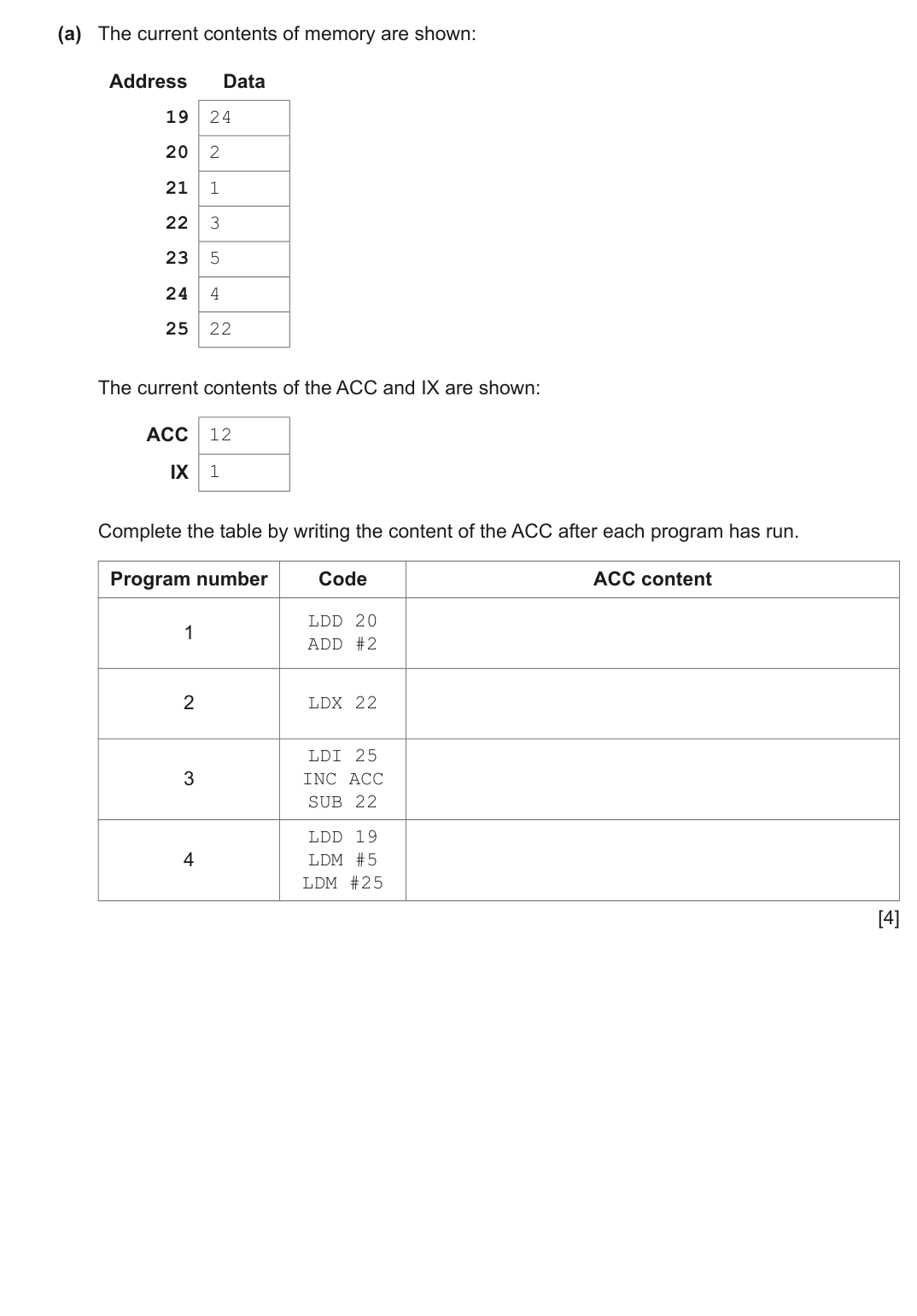
(a) The current contents of memory are shown:
Address
Data
19
24
20
2
21
1
22
3
23
5
24
4
25
22
The current contents of the ACC and IX are shown:
ACC
12
IX
1
Complete the table by writing the content of the ACC after each program has run.
Program number
Code
ACC content
1
LDD 20
ADD #2
2
LDX 22
3
LDI 25
INC ACC
SUB 22
4
LDD 19
LDM #5
LDM #25
[4]
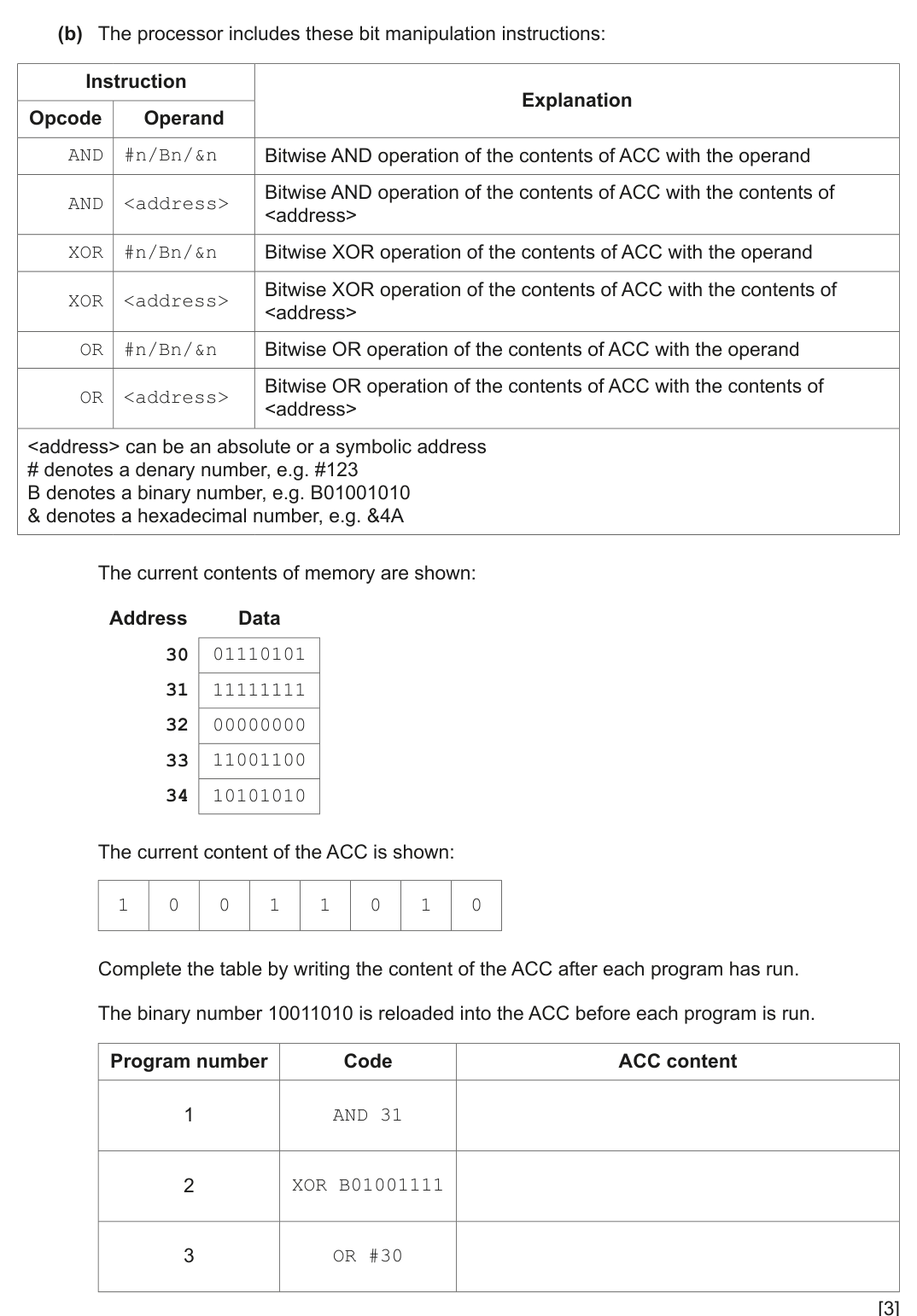
(b) The processor includes these bit manipulation instructions:
Instruction
Explanation
Opcode
Operand
AND
#n/Bn/&n
Bitwise AND operation of the contents of ACC with the operand
AND
<address>
Bitwise AND operation of the contents of ACC with the contents of
<address>
XOR
#n/Bn/&n
Bitwise XOR operation of the contents of ACC with the operand
XOR
<address>
Bitwise XOR operation of the contents of ACC with the contents of
<address>
OR
#n/Bn/&n
Bitwise OR operation of the contents of ACC with the operand
OR
<address>
Bitwise OR operation of the contents of ACC with the contents of
<address>
<address> can be an absolute or a symbolic address
# denotes a denary number, e.g. #123
B denotes a binary number, e.g. B01001010
& denotes a hexadecimal number, e.g. &4A
The current contents of memory are shown:
Address
Data
30
01110101
31
11111111
32
00000000
33
11001100
34
10101010
The current content of the ACC is shown:
1
0
0
1
1
0
1
0
Complete the table by writing the content of the ACC after each program has run.
The binary number 10011010 is reloaded into the ACC before each program is run.
Program number
Code
ACC content
1
AND 31
2
XOR B01001111
3
OR #30
[3]
Show mark scheme
4(a) [4 marks]
1 mark
for each correct answer:
Program
Code
ACC
Number
Content
LDD 20
1
4
ADD #2
LDX 22
2
5
LDI 25
3
1
INC ACC
SUB 22
LDD 19
4
25
LDM #5
LDM #25
for each correct answer:
Program
Code
ACC
Number
Content
LDD 20
1
4
ADD #2
LDX 22
2
5
LDI 25
3
1
INC ACC
SUB 22
LDD 19
4
25
LDM #5
LDM #25
4(b) [3 marks]
1 mark
for each correct answer:
Program
Code
ACC Content
Number
AND 31
1
1001 1010
XOR B01001111
2
1101 0101
OR #30
3
1001 1110
for each correct answer:
Program
Code
ACC Content
Number
AND 31
1
1001 1010
XOR B01001111
2
1101 0101
OR #30
3
1001 1110
Q5

5
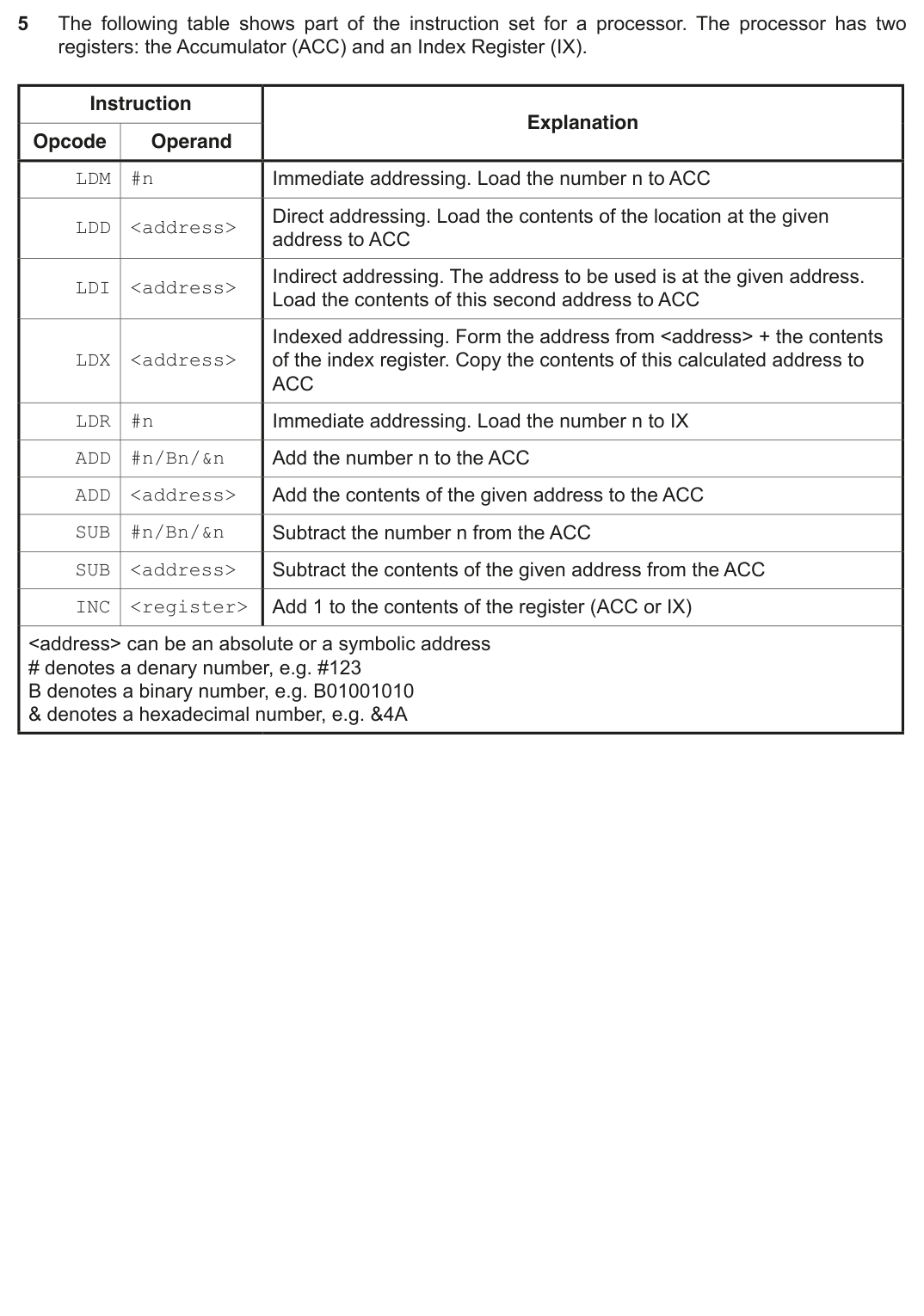
The following table shows part of the instruction set for a processor. The processor has two
registers: the Accumulator (ACC) and an Index Register (IX).
Instruction
Explanation
Opcode
Operand
LDM
#n
Immediate addressing. Load the number n to ACC
LDD
<address>
Direct addressing. Load the contents of the location at the given
address to ACC
LDI
<address>
Indirect addressing. The address to be used is at the given address.
Load the contents of this second address to ACC
LDX
<address>
Indexed addressing. Form the address from <address> + the contents
of the index register. Copy the contents of this calculated address to
ACC
LDR
#n
Immediate addressing. Load the number n to IX
ADD
#n/Bn/&n
Add the number n to the ACC
ADD
<address>
Add the contents of the given address to the ACC
SUB
#n/Bn/&n
Subtract the number n from the ACC
SUB
<address>
Subtract the contents of the given address from the ACC
INC
<register>
Add 1 to the contents of the register (ACC or IX)
<address> can be an absolute or a symbolic address
# denotes a denary number, e.g. #123
B denotes a binary number, e.g. B01001010
& denotes a hexadecimal number, e.g. &4A
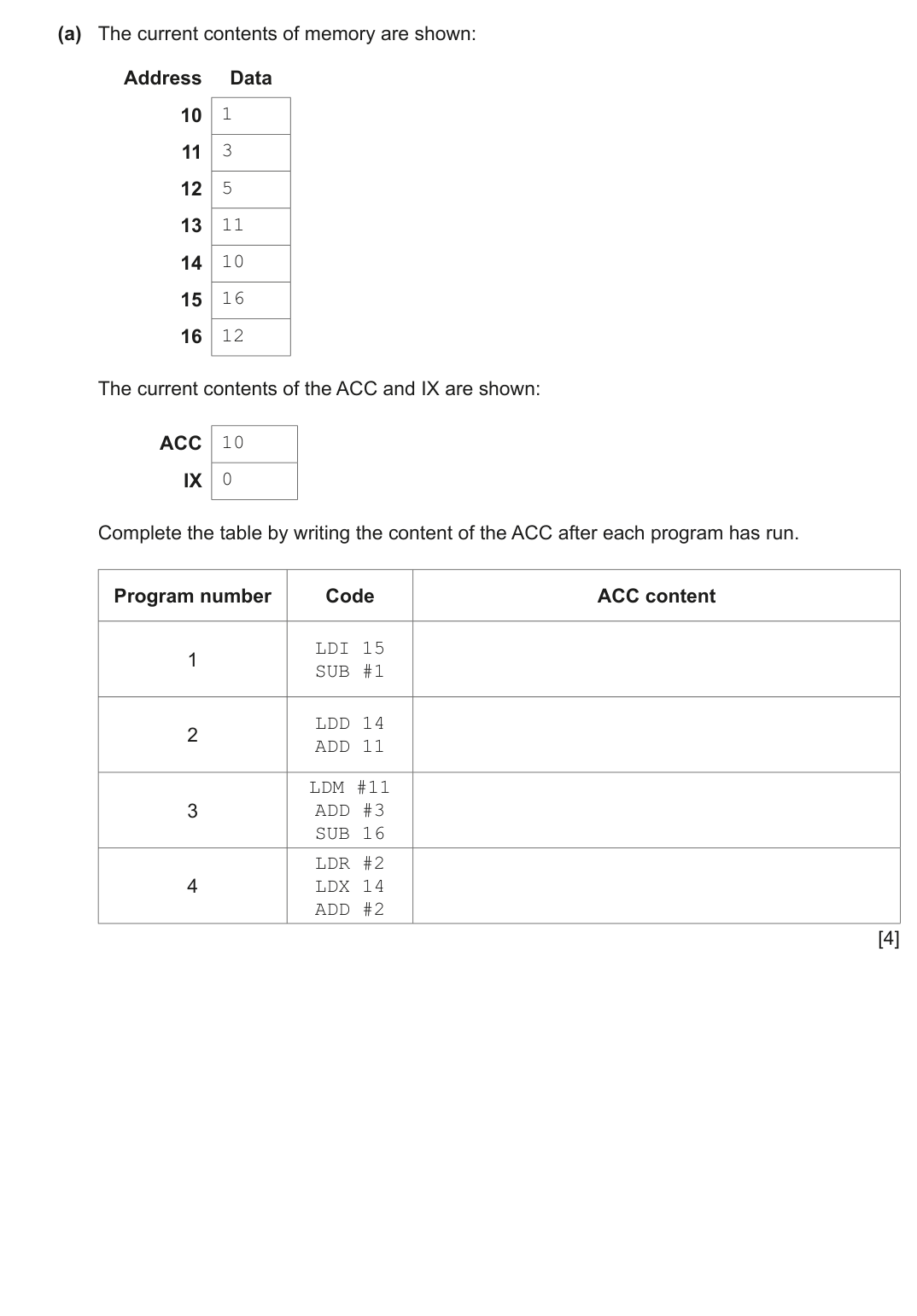
(a) The current contents of memory are shown:
Address
Data
10
1
11
3
12
5
13
11
14
10
15
16
16
12
The current contents of the ACC and IX are shown:
ACC
10
IX
0
Complete the table by writing the content of the ACC after each program has run.
Program number
Code
ACC content
1
LDI 15
SUB #1
2
LDD 14
ADD 11
3
LDM #11
ADD #3
SUB 16
4
LDR #2
LDX 14
ADD #2
[4]
(b) The processor includes these bit manipulation instructions:
Instruction
Explanation
Opcode
Operand
AND
#n/Bn/&n
Bitwise AND operation of the contents of ACC with the operand
AND
<address>
Bitwise AND operation of the contents of ACC with the contents of
<address>
XOR
#n/Bn/&n
Bitwise XOR operation of the contents of ACC with the operand
XOR
<address>
Bitwise XOR operation of the contents of ACC with the contents of
<address>
OR
#n/Bn/&n
Bitwise OR operation of the contents of ACC with the operand
OR
<address>
Bitwise OR operation of the contents of ACC with the contents of
<address>
<address> can be an absolute or a symbolic address
# denotes a denary number, e.g. #123
B denotes a binary number, e.g. B01001010
& denotes a hexadecimal number, e.g. &4A
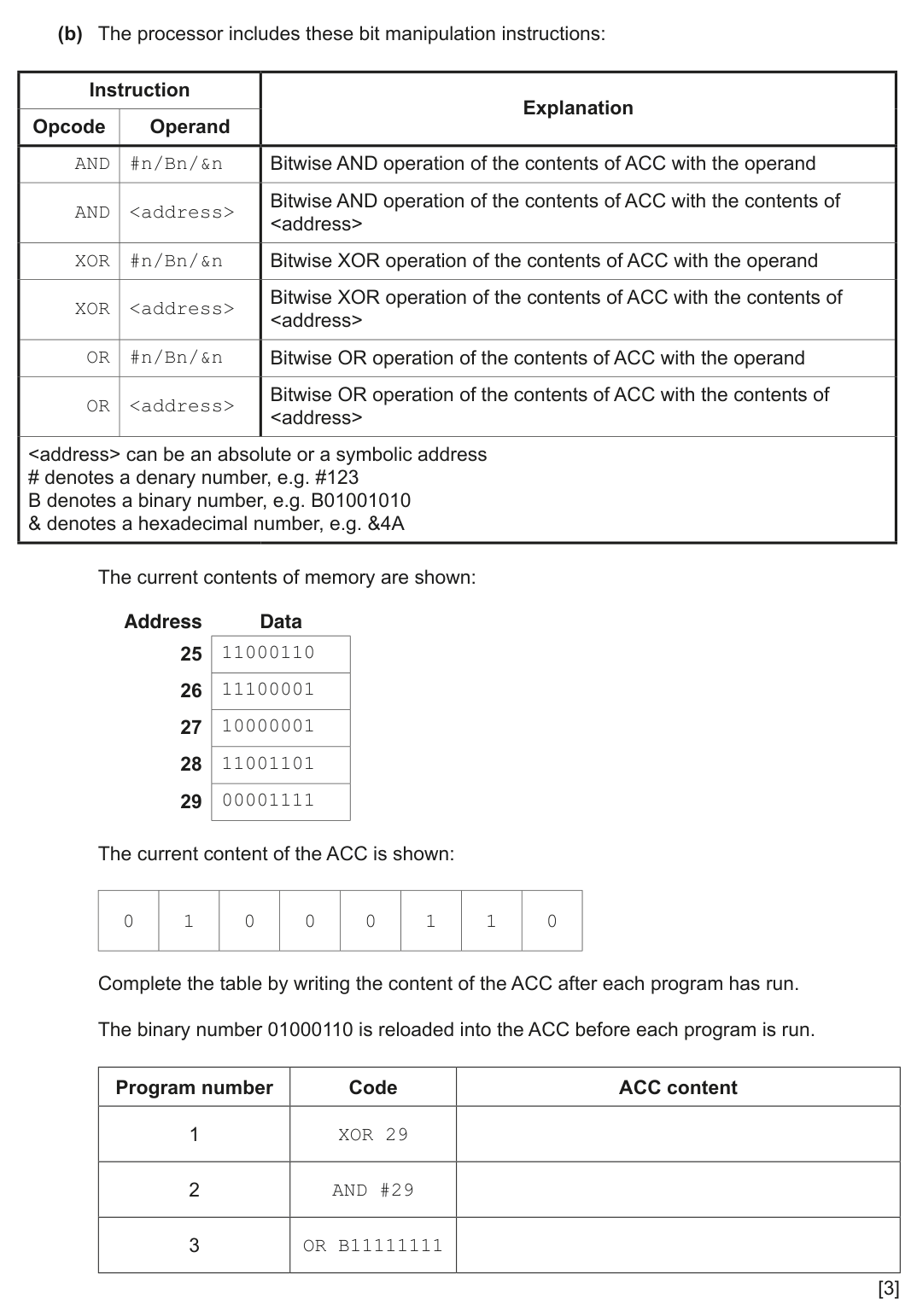
The current contents of memory are shown:
Address
Data
25
11000110
26
11100001
27
10000001
28
11001101
29
00001111
The current content of the ACC is shown:
0
1
0
0
0
1
1
0
Complete the table by writing the content of the ACC after each program has run.
The binary number 01000110 is reloaded into the ACC before each program is run.
Program number
Code
ACC content
1
XOR 29
2
AND #29
3
OR B11111111
[3]
Show mark scheme
5(a) [4 marks]
1 mark
for each correct answer:
Program
Code
ACC Content
Number
1
LDI 15
11
SUB #1
2
LDD 14
13
ADD 11
2
3
LDM #11
ADD #3
SUB 16
4
LDR #2
14
LDX 14
ADD #2
for each correct answer:
Program
Code
ACC Content
Number
1
LDI 15
11
SUB #1
2
LDD 14
13
ADD 11
2
3
LDM #11
ADD #3
SUB 16
4
LDR #2
14
LDX 14
ADD #2
5(b) [3 marks]
1 mark for
each correct answer:
Program
Code
ACC Content
Number
1
XOR 29
0100 1001
2
AND #29
0000 0100
3
OR B11111111
1111 1111
each correct answer:
Program
Code
ACC Content
Number
1
XOR 29
0100 1001
2
AND #29
0000 0100
3
OR B11111111
1111 1111
Q3

3
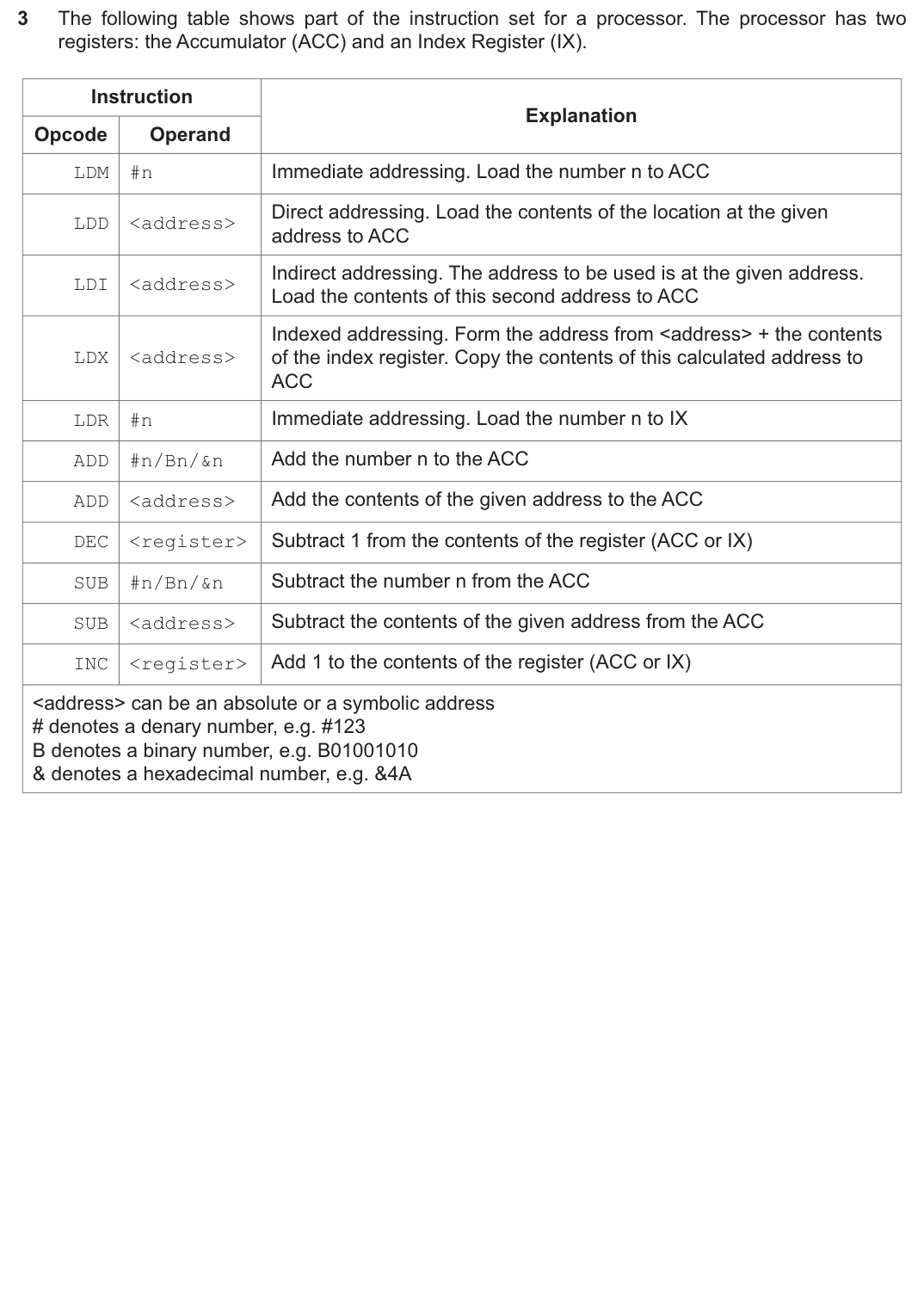
The following table shows part of the instruction set for a processor. The processor has two
registers: the Accumulator (ACC) and an Index Register (IX).
Instruction
Explanation
Opcode
Operand
LDM
#n
Immediate addressing. Load the number n to ACC
LDD
<address>
Direct addressing. Load the contents of the location at the given
address to ACC
LDI
<address>
Indirect addressing. The address to be used is at the given address.
Load the contents of this second address to ACC
LDX
<address>
Indexed addressing. Form the address from <address> + the contents
of the index register. Copy the contents of this calculated address to
ACC
LDR
#n
Immediate addressing. Load the number n to IX
ADD
#n/Bn/&n
Add the number n to the ACC
ADD
<address>
Add the contents of the given address to the ACC
DEC
<register>
Subtract 1 from the contents of the register (ACC or IX)
SUB
#n/Bn/&n
Subtract the number n from the ACC
SUB
<address>
Subtract the contents of the given address from the ACC
INC
<register>
Add 1 to the contents of the register (ACC or IX)
<address> can be an absolute or a symbolic address
# denotes a denary number, e.g. #123
B denotes a binary number, e.g. B01001010
& denotes a hexadecimal number, e.g. &4A
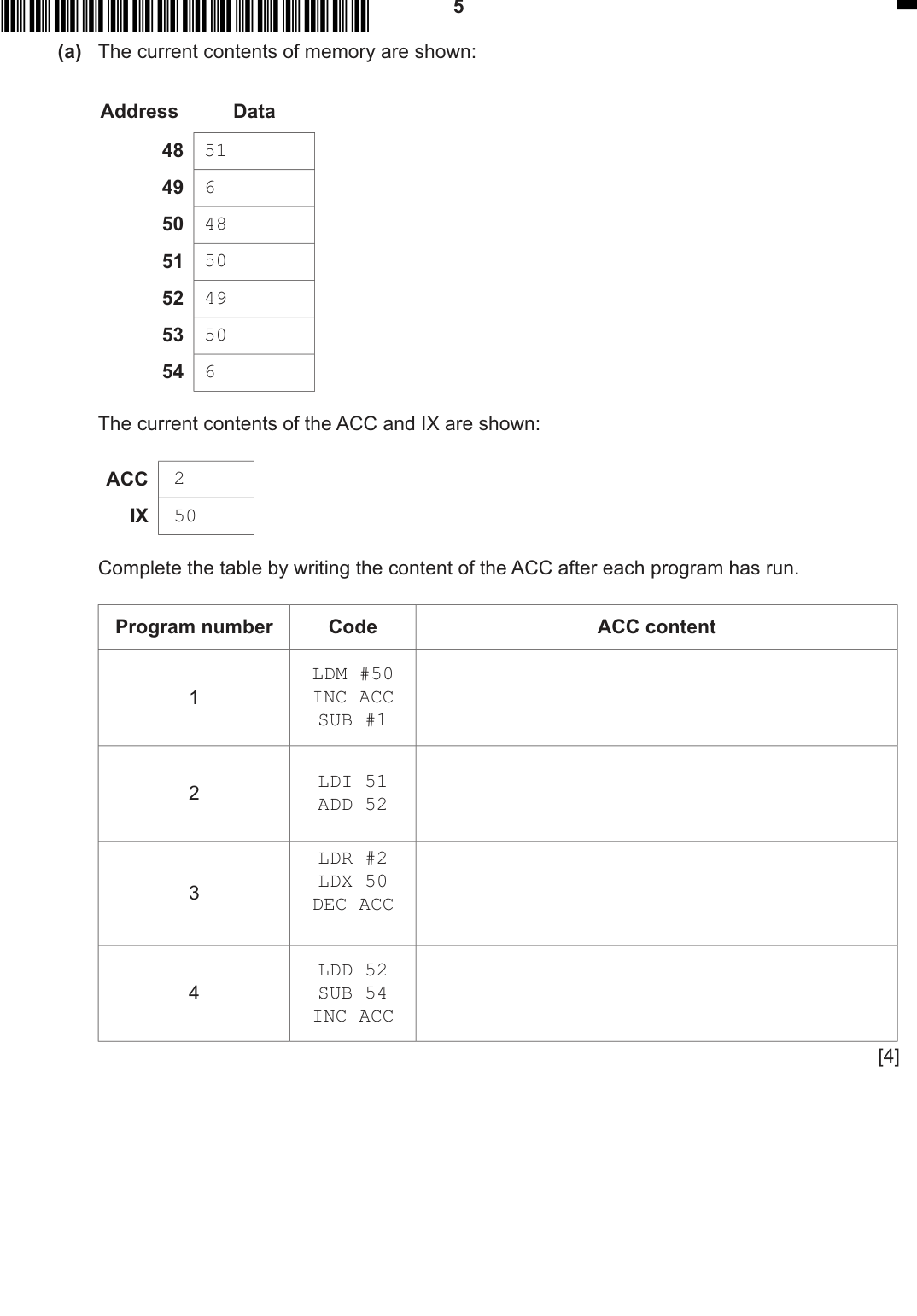
(a) The current contents of memory are shown:
Address
Data
48
51
49
6
50
48
51
50
52
49
53
50
54
6
The current contents of the ACC and IX are shown:
ACC
2
IX
50
Complete the table by writing the content of the ACC after each program has run.
Program number
Code
ACC content
1
LDM #50
INC ACC
SUB #1
2
LDI 51
ADD 52
3
LDR #2
LDX 50
DEC ACC
4
LDD 52
SUB 54
INC ACC
[4]
,
,
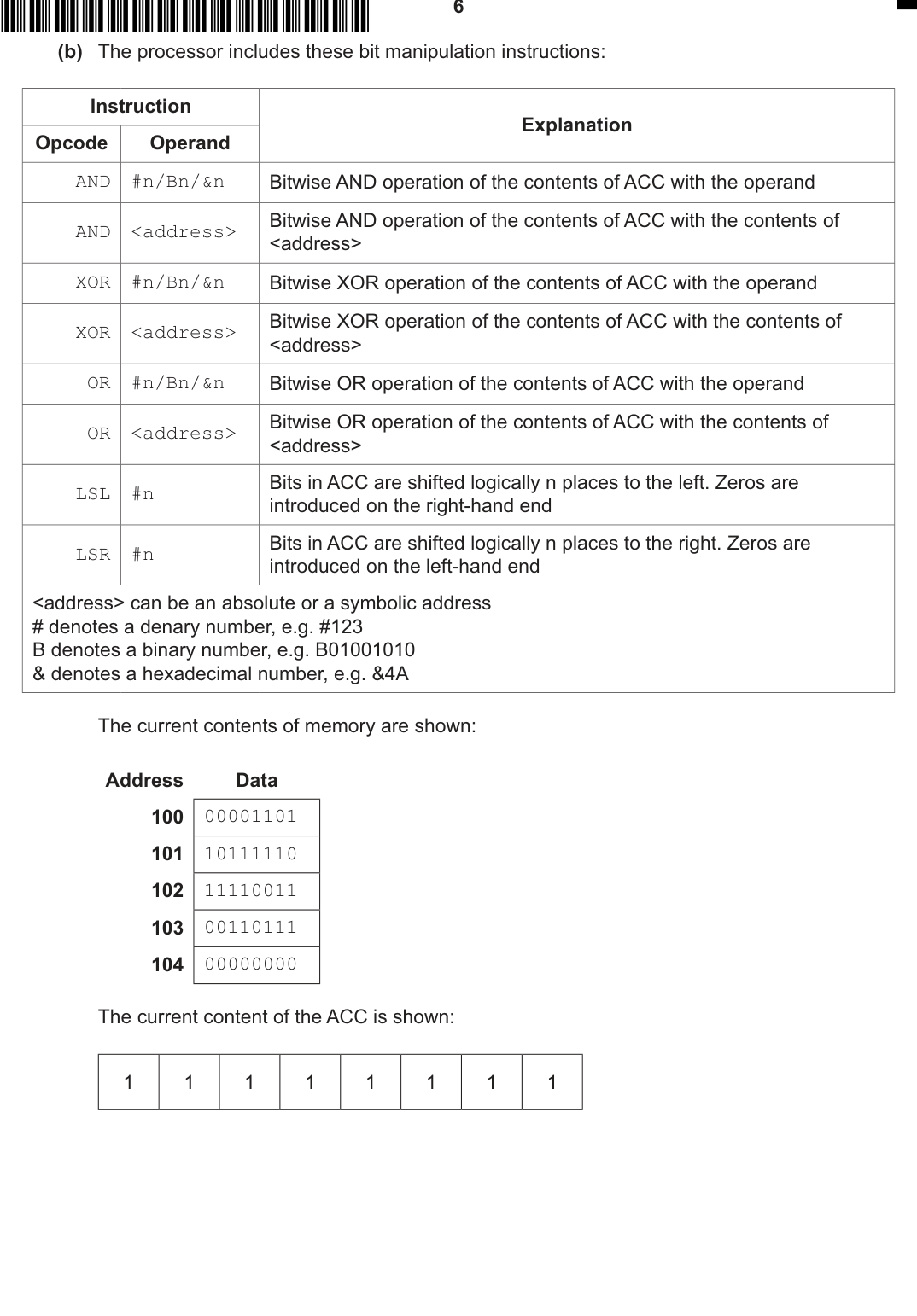
(b) The processor includes these bit manipulation instructions:
Instruction
Explanation
Opcode
Operand
AND
#n/Bn/&n
Bitwise AND operation of the contents of ACC with the operand
AND
<address>
Bitwise AND operation of the contents of ACC with the contents of
<address>
XOR
#n/Bn/&n
Bitwise XOR operation of the contents of ACC with the operand
XOR
<address>
Bitwise XOR operation of the contents of ACC with the contents of
<address>
OR
#n/Bn/&n
Bitwise OR operation of the contents of ACC with the operand
OR
<address>
Bitwise OR operation of the contents of ACC with the contents of
<address>
LSL
#n
Bits in ACC are shifted logically n places to the left. Zeros are
introduced on the right-hand end
LSR
#n
Bits in ACC are shifted logically n places to the right. Zeros are
introduced on the left-hand end
<address> can be an absolute or a symbolic address
# denotes a denary number, e.g. #123
B denotes a binary number, e.g. B01001010
& denotes a hexadecimal number, e.g. &4A
The current contents of memory are shown:
Address
Data
100
00001101
101
10111110
102
11110011
103
00110111
104
00000000
The current content of the ACC is shown:
1
1
1
1
1
1
1
1
,
,
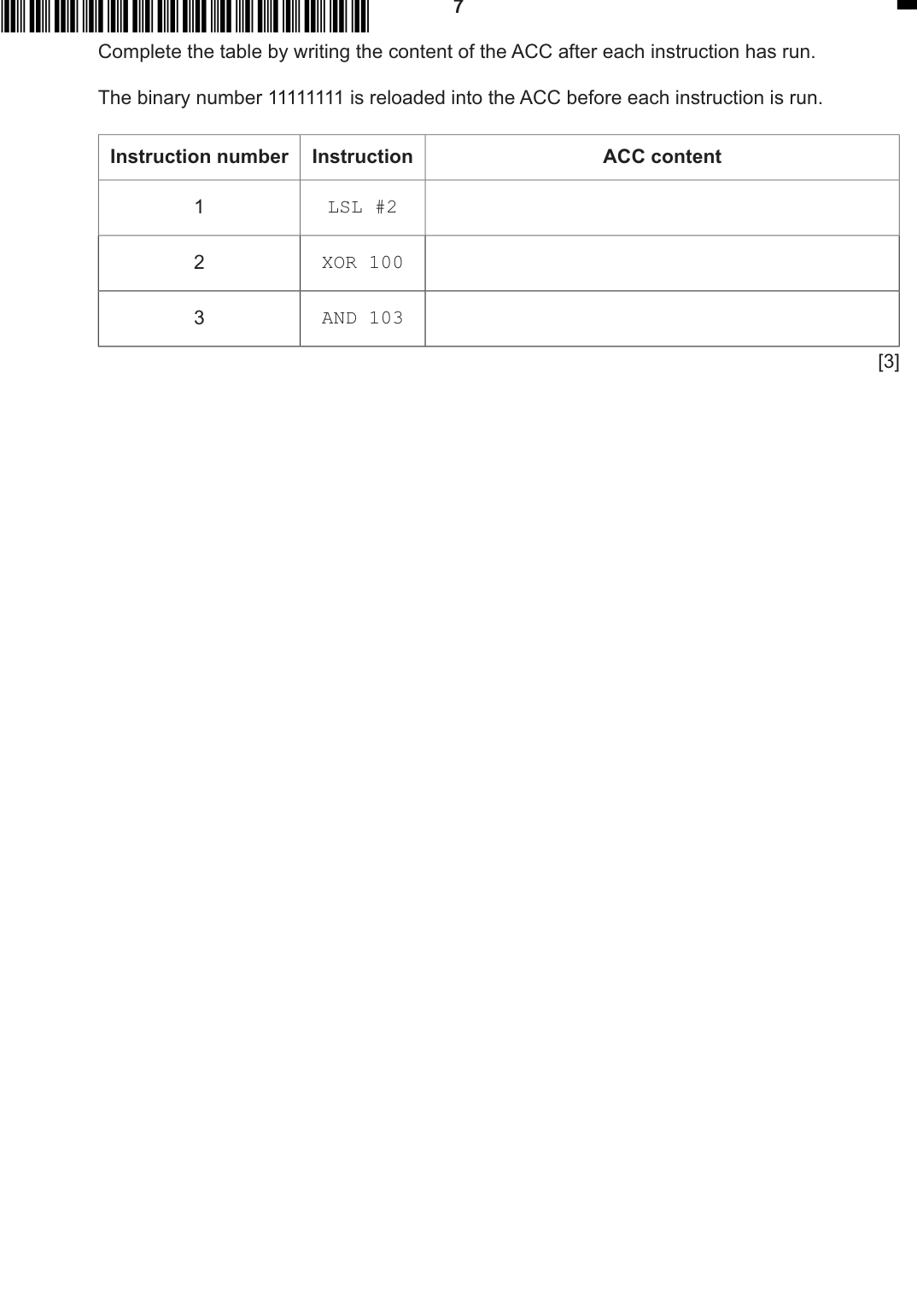
Complete the table by writing the content of the ACC after each instruction has run.
The binary number 11111111 is reloaded into the ACC before each instruction is run.
Instruction number
Instruction
ACC content
1
LSL #2
2
XOR 100
3
AND 103
[3]
,
,
,
,
Show mark scheme
3(a) [4 marks]
1 mark
for each correct answer:
Program
Code
ACC
Number
Content
LDM #50
1
50
INC ACC
SUB #1
LDI 51
2
97
ADD 52
LDR #2
3
48
LDX 50
DEC ACC
LDD 52
4
44
SUB 54
INC ACC
for each correct answer:
Program
Code
ACC
Number
Content
LDM #50
1
50
INC ACC
SUB #1
LDI 51
2
97
ADD 52
LDR #2
3
48
LDX 50
DEC ACC
LDD 52
4
44
SUB 54
INC ACC
3(b) [3 marks]
1 mark
for each correct answer:
Instruction
Instruction
ACC Content
Number
LSL #2
1
1111 1100
XOR 100
2
1111 0010
AND 103
3
0011 0111
for each correct answer:
Instruction
Instruction
ACC Content
Number
LSL #2
1
1111 1100
XOR 100
2
1111 0010
AND 103
3
0011 0111